

Ch. 2 - Limits and Continuity
Hass - Thomas' Calculus 15th Edition
Hass15th EditionThomas' CalculusISBN: 9780137616077Not the one you use?Change textbook
Chapter 2, Problem 2.P.2

Limits and Continuity
Repeat the instructions of Exercise 1 for


1 , x ≤ ―1
1/x , 0 < |x| < 1
ƒ(x) = { 0, x = 1 ,
1 , x > 1 .

Verified step by step guidance
1
First, identify the piecewise function given: \( f(x) = \begin{cases} 1, & x \leq -1 \\ 1/x, & 0 < |x| < 1 \\ 0, & x = 1 \\ 1, & x > 1 \end{cases} \).
To analyze the limits and continuity, consider each interval separately. Start with \( x \leq -1 \), where \( f(x) = 1 \). The function is constant, so it is continuous in this interval.
Next, examine the interval \( 0 < |x| < 1 \), where \( f(x) = 1/x \). Check the limit as \( x \) approaches 0 from both sides. Since \( 1/x \) becomes unbounded as \( x \) approaches 0, the function is not continuous at \( x = 0 \).
Consider \( x = 1 \), where \( f(x) = 0 \). Evaluate the limit from the left and right of \( x = 1 \). From the left, \( f(x) = 1/x \) approaches 1, and from the right, \( f(x) = 1 \). Since the limits from both sides do not equal \( f(1) = 0 \), the function is not continuous at \( x = 1 \).
Finally, for \( x > 1 \), \( f(x) = 1 \). The function is constant, so it is continuous in this interval. Summarize the continuity: \( f(x) \) is continuous for \( x \leq -1 \) and \( x > 1 \), but not at \( x = 0 \) or \( x = 1 \).

Verified video answer for a similar problem:

This video solution was recommended by our tutors as helpful for the problem above.
Video duration:
4m
Was this helpful?

Key Concepts

Here are the essential concepts you must grasp in order to answer the question correctly.

Limits

Limits are fundamental in calculus, describing the behavior of a function as its input approaches a particular point. Understanding limits is crucial for analyzing the function's behavior near points of interest, especially where the function may not be explicitly defined. In this context, limits help determine the value that f(x) approaches as x approaches specific values, such as -1, 0, or 1.
Recommended video:
05:50
One-Sided Limits

Continuity

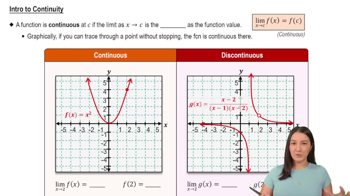
Continuity of a function at a point means that the function is defined at that point, the limit exists at that point, and the limit equals the function's value. A function is continuous over an interval if it is continuous at every point within that interval. For the given piecewise function, assessing continuity involves checking these conditions at the transition points x = -1, 0, and 1.
Recommended video:
05:34
Intro to Continuity

Piecewise Functions

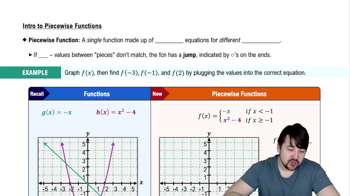
Piecewise functions are defined by different expressions over different intervals of the domain. Understanding how to evaluate and analyze these functions involves considering each piece separately and ensuring the function's overall behavior is consistent with the conditions of limits and continuity. In this problem, the function f(x) is defined differently over three intervals, requiring careful examination of each segment.
Recommended video:
05:36
Piecewise Functions
Related Practice
Textbook Question

Limits of Average Rates of Change


Because of their connection with secant lines, tangents, and instantaneous rates, limits of the form limh→0 (f(x+h) − f(x)) / h occur frequently in calculus. In Exercises 57–62, evaluate this limit for the given value of x and function f.


f(x) = x², x = -2

310
views
Textbook Question

Centering Intervals About a Point


In Exercises 1–6, sketch the interval (a,b), on the x-axis with the point c inside. Then find a value of δ>0 such that a < x < b whenever 0 < |x−c| < δ.


a=4/9, b=4/7, c=1/2

362
views
Textbook Question

Theory and Examples


a. If limx→0 f(x) / x² = 1, find limx→0 f(x).

255
views
Textbook Question

Limits as x → ∞ or x → −∞


The process by which we determine limits of rational functions applies equally well to ratios containing noninteger or negative powers of x. Divide numerator and denominator by the highest power of x in the denominator and proceed from there. Find the limits in Exercises 23–36. Write ∞ or −∞ where appropriate.


lim x→∞ (2√x + x⁻¹) / (3x − 7)

296
views
Textbook Question

Limits and Continuity


Graph the function


1 , x ≤ ―1

―x , ―1 < x < 0

ƒ(x) = { 1 , x = 0 ,

―x , 0 < x < 1

1 , x ≥ 1


Then discuss, in detail, limits, one-sided limits, continuity, and one-sided continuity of ƒ at x = ―1 , 0 , and 1. Are any of the discontinuities removable? Explain.

226
views
Textbook Question

Finding Limits Graphically


Let f(x) = {3 - x , x < 2

2, x = 2

x/2, x > 2


<IMAGE>


a. Find limx→2+ f(x), limx→2− f(x), and f(2).

314
views