Ch. 3 - Derivatives
Briggs - Calculus: Early Transcendentals 3rd Edition
Briggs3rd EditionCalculus: Early TranscendentalsISBN: 9780136847243Not the one you use?Change textbook
Chapter 3, Problem 11

Let F(x) = f(x) + g(x),G(x) = f(x) - g(x), and H(x) = 3f(x) + 2g(x), where the graphs of f and g are shown in the figure. Find each of the following.
<IMAGE>
H'(2)

Verified step by step guidance
1
Step 1: Understand the problem. We are given three functions: F(x) = f(x) + g(x), G(x) = f(x) - g(x), and H(x) = 3f(x) + 2g(x). We need to find the derivative of H at x = 2, denoted as H'(2).
Step 2: Use the linearity of differentiation. The derivative of a sum is the sum of the derivatives, and the derivative of a constant times a function is the constant times the derivative of the function. Therefore, H'(x) = 3f'(x) + 2g'(x).
Step 3: Evaluate the derivatives of f and g at x = 2. From the graph, determine the values of f'(2) and g'(2). These are the slopes of the tangent lines to the graphs of f and g at x = 2.
Step 4: Substitute the values of f'(2) and g'(2) into the expression for H'(x). This gives H'(2) = 3f'(2) + 2g'(2).
Step 5: Calculate H'(2) using the values obtained from the graph. This will give you the rate of change of H at x = 2.

Verified video answer for a similar problem:

This video solution was recommended by our tutors as helpful for the problem above.
Video duration:
5m

Key Concepts

Here are the essential concepts you must grasp in order to answer the question correctly.

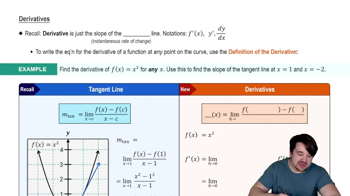
Derivative

The derivative of a function measures the rate at which the function's value changes as its input changes. It is a fundamental concept in calculus, representing the slope of the tangent line to the graph of the function at a given point. For a function F(x), the derivative F'(x) can be found using rules such as the sum, difference, and constant multiple rules.
Recommended video:

Sum and Difference of Functions

When dealing with the sum or difference of two functions, the derivative can be computed by applying the sum and difference rules. Specifically, if F(x) = f(x) + g(x), then F'(x) = f'(x) + g'(x). Similarly, for G(x) = f(x) - g(x), G'(x) = f'(x) - g'(x). This property allows for the straightforward calculation of derivatives for combined functions.
Recommended video:
Guided course
06:11
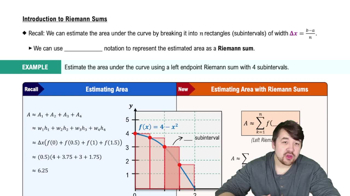
Introduction to Riemann Sums

Linear Combination of Functions

A linear combination of functions involves multiplying each function by a constant and then adding the results. In the case of H(x) = 3f(x) + 2g(x), the coefficients 3 and 2 indicate how much each function contributes to H. The derivative of H can be found by applying the constant multiple rule, which states that the derivative of a constant multiplied by a function is the constant multiplied by the derivative of the function.
Recommended video:
Guided course
07:17
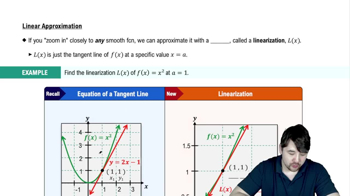
Linearization