Ch. 2 - Limits
Briggs - Calculus: Early Transcendentals 3rd Edition
Briggs3rd EditionCalculus: Early TranscendentalsISBN: 9780136847243Not the one you use?Change textbook
Chapter 2, Problem 91

Calculate the following limits using the factorization formula x^n−a^n=(x−a)(x^n−1+ax^n−2+a^2x^n−3+⋯+a^n−2x+a^n−1), where n is a positive integer and a is a real number.
lim x→1 x^6 − 1 / x − 1

Verified step by step guidance
1
Recognize that the given limit is in the indeterminate form 0/0 when x approaches 1, so we need to simplify the expression.
Use the factorization formula for x^n - a^n: x^6 - 1 = (x - 1)(x^5 + x^4 + x^3 + x^2 + x + 1).
Substitute the factorized form into the limit: lim_{x \(\to\) 1} \(\frac{(x - 1)(x^5 + x^4 + x^3 + x^2 + x + 1)}{x - 1}\).
Cancel the common factor (x - 1) in the numerator and the denominator.
Evaluate the limit of the remaining expression x^5 + x^4 + x^3 + x^2 + x + 1 as x approaches 1.

Verified video answer for a similar problem:

This video solution was recommended by our tutors as helpful for the problem above.
Video duration:
4m
Was this helpful?

Key Concepts

Here are the essential concepts you must grasp in order to answer the question correctly.

Limits

Limits are fundamental in calculus, representing the value that a function approaches as the input approaches a certain point. In this context, we are interested in evaluating the limit of a rational function as x approaches 1, which often involves determining the behavior of the function near that point.
Recommended video:
05:50
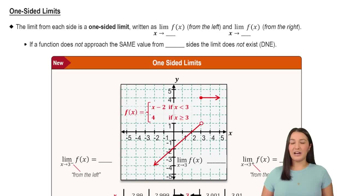
One-Sided Limits

Factorization

Factorization is the process of breaking down an expression into a product of simpler factors. The provided factorization formula for x^n - a^n allows us to simplify the limit calculation by rewriting the expression in a form that eliminates indeterminate forms, such as 0/0, which can occur when directly substituting the limit point.
Recommended video:
06:11
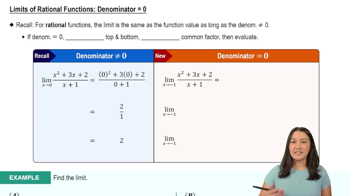
Limits of Rational Functions: Denominator = 0

Polynomial Functions

Polynomial functions are expressions that involve variables raised to whole number powers, combined using addition, subtraction, and multiplication. In this limit problem, x^6 - 1 is a polynomial, and understanding its structure helps in applying the factorization formula effectively to find the limit as x approaches 1.
Recommended video:
6:04
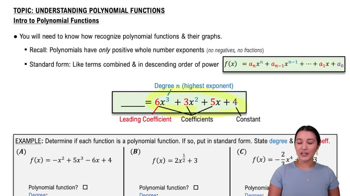
Introduction to Polynomial Functions
Related Practice
Textbook Question

Let g(x)= {1 if x≥0

−1 if x<0.


a. Write a formula for |g(x)|.

366
views

Textbook Question

Suppose you park your car at a trailhead in a national park and begin a 2-hr hike to a lake at 7 A.M. on a Friday morning. On Sunday morning, you leave the lake at 7 A.M. and start the 2-hr hike back to your car. Assume the lake is 3 mi from your car. Let f(t) be your distance from the car t hours after 7 a.m. on Friday morning, and let g(t) be your distance from the car t hours after 7 a.m. on Sunday morning.


b. Let h(t)=f(t)−g(t). Find h(0) and h(2).

218
views
Textbook Question

Use an appropriate limit definition to prove the following limits.


lim x→1 (5x−2) =3;

365
views
Textbook Question

Suppose f(x) = {x^2 − 5x + 6 / x − 3 if x≠3

a if x=3.

Determine a value of the constant a for which lim x→3 f(x) = f(3).

400
views
Textbook Question

Suppose you park your car at a trailhead in a national park and begin a 2-hr hike to a lake at 7 A.M. on a Friday morning. On Sunday morning, you leave the lake at 7 A.M. and start the 2-hr hike back to your car. Assume the lake is 3 mi from your car. Let f(t) be your distance from the car t hours after 7 a.m. on Friday morning, and let g(t) be your distance from the car t hours after 7 a.m. on Sunday morning.


a. Evaluate f(0), f(2), g(0), and g(2).

324
views
Textbook Question

Suppose g(x) = {x^2−5x if x≤−1

ax^3−7 if x>−1.

Determine a value of the constant a for which lim x→−1 g(x) exists and state the value of the limit, if possible.

356
views