

Ch. 2 - Exploring Data with Tables and Graphs
Triola - Elementary Statistics 14th Edition
Triola14th EditionElementary StatisticsISBN: 9780137366446Not the one you use?Change textbook
Chapter 2, Problem 2.3.5

In Exercises 5 and 6, construct the dotplot.


Pulse Rates Listed below are pulse rates (beats per minute) of females selected from Data Set 1 “Body Data” in Appendix B. All of those pulse rates are even numbers. Is there a pulse rate that appears to be an outlier? What is its value?


Verified step by step guidance
1
Step 1: Organize the pulse rates in ascending order to make it easier to identify patterns and potential outliers. The ordered data is: 36, 56, 56, 58, 60, 64, 64, 64, 66, 66, 66, 66, 76, 76, 78, 78, 78, 78, 80, 82, 84, 86, 86, 88, 94.
Step 2: Construct a dotplot by plotting each pulse rate value on a horizontal axis, with the number of dots above each value corresponding to its frequency in the dataset. This visual representation will help identify any values that stand out significantly from the rest.
Step 3: Calculate the interquartile range (IQR) to determine the range of typical values. First, find the first quartile (Q1) and third quartile (Q3) of the data. Q1 is the median of the lower half of the data, and Q3 is the median of the upper half. Then, compute the IQR using the formula: IQR=Q3-Q1.
Step 4: Use the IQR to identify potential outliers. Any value that is below Q1-1.5×IQR or above Q3+1.5×IQR is considered an outlier.
Step 5: Compare the pulse rates to the calculated thresholds for outliers. Identify any values that fall outside these thresholds and confirm whether they are outliers. Highlight the outlier value, if any, based on this analysis.

Verified video answer for a similar problem:

This video solution was recommended by our tutors as helpful for the problem above.
Video duration:
6m
Was this helpful?

Key Concepts

Here are the essential concepts you must grasp in order to answer the question correctly.

Dot Plot

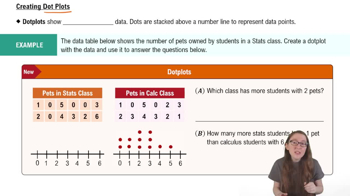
A dot plot is a simple graphical display used to represent the frequency of data points in a dataset. Each data point is represented by a dot above a number line, allowing for easy visualization of the distribution, clusters, and gaps in the data. In this exercise, constructing a dot plot of pulse rates will help identify patterns and potential outliers.
Recommended video:
04:01
Creating Dotplots

Outlier

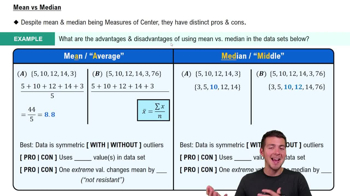
An outlier is a data point that significantly differs from other observations in a dataset. It can be unusually high or low compared to the rest of the data. Identifying outliers is crucial as they can skew statistical analyses and affect interpretations. In the context of pulse rates, determining if any value stands out as an outlier will provide insights into the overall health data.
Recommended video:
Guided course
04:48
Comparing Mean vs. Median

Pulse Rate

Pulse rate, measured in beats per minute (BPM), indicates the number of times the heart beats in a minute. It is a vital sign used to assess cardiovascular health. In this exercise, analyzing the pulse rates of females will help understand the typical range and identify any abnormal values that may indicate health issues or anomalies.
Recommended video:
Guided course
03:08
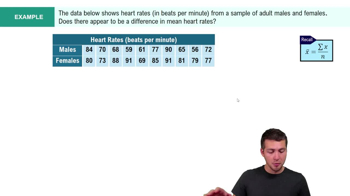
Calculating the Mean Example 1
Related Practice
Textbook Question

Presidents Listed below are the ages (years) of presidents of the United States at the times of their first inaugurations (from Data Set 22 “Presidents” in Appendix B). Presidents who took office as a result of an assassination or resignation are not included. The data are current as of this writing. Use these ages to construct a frequency distribution. Use a class width of 5 years and begin with a lower class limit of 40 years. Do the ages appear to have a normal distribution?

244
views
Textbook Question

Hershey Kisses Refer to Data Set 38 “Candies” and use the weights (grams) of Hershey’s Kisses. Begin with a lower class limit of 4.300 g and use a class width of 0.100 g. Does this distribution appear to be a normal distribution?

144
views
Textbook Question

Exercises 29–34 involve large sets of data, so technology should be used. Complete lists of the data are not listed in Appendix B, but they can be downloaded from the website TriolaStats.com. Use the indicated data and construct the frequency distribution.


Diastolic Blood Pressure Use the diastolic blood pressures of the 300 subjects included in Data Set 1 “Body Data.” Use a class width of 15 mm Hg and begin with a lower class limit of 40 mm Hg. Does the frequency distribution appear to be a normal distribution?

160
views
Textbook Question

In Exercises 9–18, construct the histograms and answer the given questions.


Tornadoes Use the frequency distribution from Exercise 16 in Section 2-1 to construct a histogram. Does the histogram appear to be skewed? If so, identify the type of skewness.

134
views
Textbook Question

More IQ Scores The population of IQ scores of adults is normally distributed. If we obtain a voluntary response sample of 5000 of those IQ scores, will a histogram of the sample be bell-shaped?

185
views
Textbook Question

In Exercises 9–18, construct the histograms and answer the given questions.


Hershey’s Kisses Use the frequency distribution from Exercise 20 in Section 2-1 to construct a histogram. In using a strict interpretation of the criteria for being a normal distribution, does the histogram appear to depict data from a population with a normal distribution?

145
views