Ch. 11 Cardiovascular System
Marieb - Essentials of Human Anatomy & Physiology 13th Edition
Marieb13th EditionEssentials of Human Anatomy & PhysiologyISBN: 9780135624340Not the one you use?Change textbook
Chapter 11, Problem 12

More than one choice may apply.
Which layer of the artery wall thickens most in atherosclerosis?
a. Tunica media
b. Tunica intima
c. Tunica adventitia
d. Tunica externa

Verified step by step guidance
1
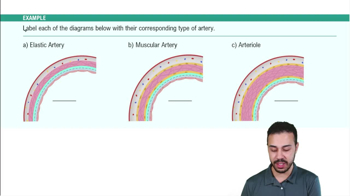
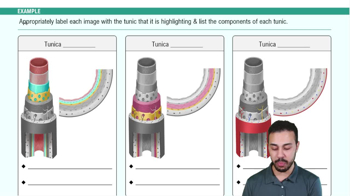
Understand the structure of an artery wall: Arteries have three layers—tunica intima (innermost layer), tunica media (middle layer), and tunica adventitia or tunica externa (outermost layer). Each layer has distinct functions and characteristics.
Learn about atherosclerosis: Atherosclerosis is a condition where plaque builds up inside the arteries, leading to thickening and hardening of the arterial walls. This process primarily affects specific layers of the artery.
Focus on the tunica intima: The tunica intima is the innermost layer of the artery and is directly exposed to blood flow. It consists of endothelial cells and a thin layer of connective tissue. In atherosclerosis, this layer thickens due to the accumulation of lipids, inflammatory cells, and fibrous tissue.
Consider the tunica media: The tunica media is the middle layer composed of smooth muscle cells and elastic fibers. While it may be indirectly affected by atherosclerosis, the primary thickening occurs in the tunica intima.
Eliminate other options: The tunica adventitia or tunica externa, the outermost layer, is primarily composed of connective tissue and does not thicken significantly in atherosclerosis. This helps narrow down the correct answer to the tunica intima as the layer most affected.

Verified video answer for a similar problem:

This video solution was recommended by our tutors as helpful for the problem above.
Video duration:
2m
Was this helpful?

Key Concepts

Here are the essential concepts you must grasp in order to answer the question correctly.

Atherosclerosis

Atherosclerosis is a condition characterized by the buildup of fatty deposits, cholesterol, and other substances in the arterial walls, leading to the formation of plaques. This process narrows the arteries and can restrict blood flow, increasing the risk of cardiovascular diseases. Understanding atherosclerosis is crucial for identifying which layer of the artery wall is most affected.

Layers of the Artery Wall

The artery wall consists of three main layers: the tunica intima (inner layer), tunica media (middle layer), and tunica adventitia (outer layer). Each layer has distinct functions, with the tunica media primarily responsible for regulating blood vessel diameter and blood pressure. Recognizing these layers is essential for understanding how atherosclerosis impacts arterial structure.
Recommended video:
1:42
Arteries Example 1

Tunica Intima

The tunica intima is the innermost layer of the artery wall, composed of endothelial cells that provide a smooth surface for blood flow. In atherosclerosis, this layer thickens due to the accumulation of lipids and inflammatory cells, leading to plaque formation. Identifying the tunica intima's role in atherosclerosis is key to answering the question about which layer thickens most significantly.
Recommended video:
4:24
General Blood Vessel Structure Example 1