Ch. 5 The Skeletal System
Marieb - Essentials of Human Anatomy & Physiology 13th Edition
Marieb13th EditionEssentials of Human Anatomy & PhysiologyISBN: 9780135624340Not the one you use?Change textbook
Chapter 5, Problem 13

What is yellow marrow? How do spongy and compact bone look different?

Verified step by step guidance
1
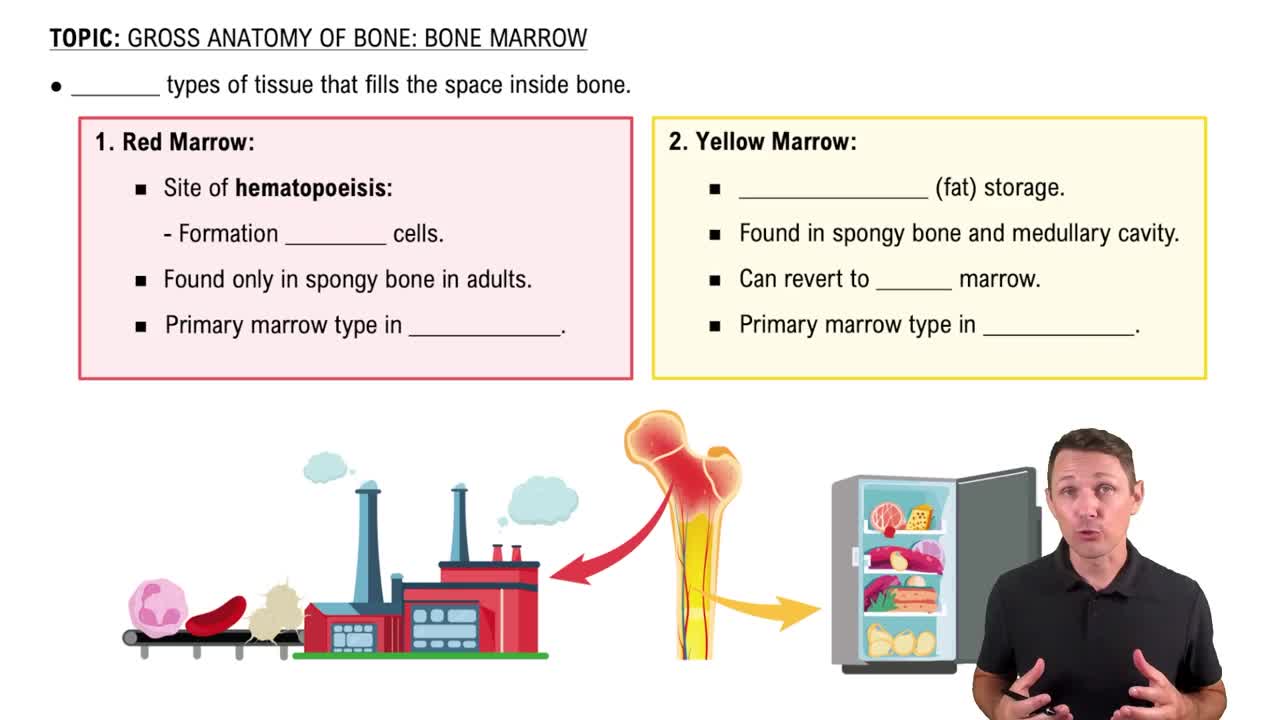
Yellow marrow is a type of bone marrow primarily composed of adipose tissue (fat cells). It is found in the medullary cavity of long bones and serves as an energy reserve. Additionally, it can convert to red marrow under certain conditions, such as severe blood loss, to aid in blood cell production.
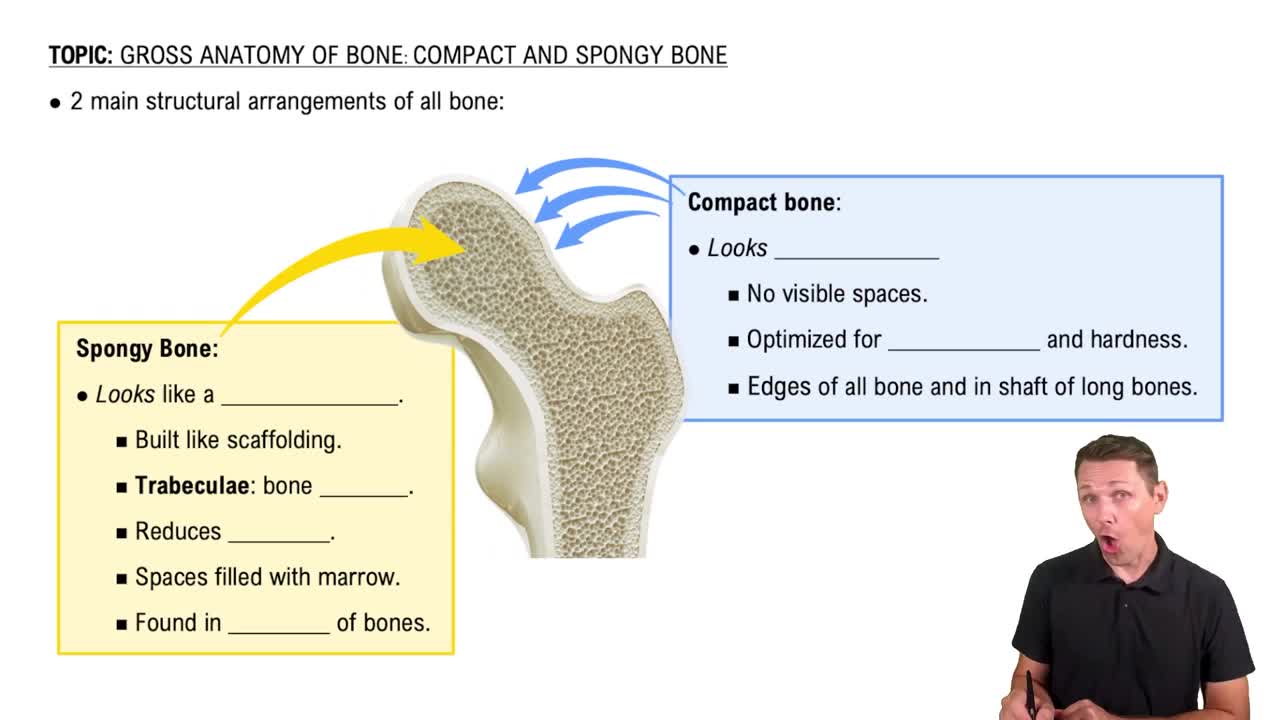
Spongy bone, also known as cancellous or trabecular bone, has a porous, lattice-like structure made up of trabeculae. These trabeculae are small, needle-like or flat pieces of bone that create spaces filled with red or yellow marrow. Spongy bone is typically found at the ends of long bones and in the interior of other bones, such as the vertebrae.
Compact bone, also known as cortical bone, has a dense and solid structure. It is organized into cylindrical units called osteons (or Haversian systems), which consist of concentric lamellae surrounding a central canal that contains blood vessels and nerves. Compact bone forms the outer layer of bones and provides strength and protection.
The visual difference between spongy and compact bone is that spongy bone appears porous and less dense, resembling a honeycomb, while compact bone looks smooth and solid under a microscope or in cross-section.
The functional difference is that spongy bone is designed to absorb stress and reduce the weight of the skeleton, while compact bone provides structural support and protection for the body.

Verified video answer for a similar problem:

This video solution was recommended by our tutors as helpful for the problem above.
Video duration:
3m
Was this helpful?

Key Concepts

Here are the essential concepts you must grasp in order to answer the question correctly.

Yellow Marrow

Yellow marrow is a type of bone marrow primarily composed of adipose (fat) tissue. It serves as a fat storage area and is found in the central cavities of long bones. Unlike red marrow, which is responsible for blood cell production, yellow marrow plays a more supportive role in energy storage and can convert back to red marrow in cases of severe blood loss.
Recommended video:

Spongy Bone

Spongy bone, also known as cancellous bone, is characterized by a porous, lattice-like structure that provides strength while being lightweight. It is typically found at the ends of long bones and in the interiors of others, allowing for the storage of bone marrow and the absorption of shock. The spaces within spongy bone are filled with red marrow, which is crucial for hematopoiesis.
Recommended video:
Guided course
3:43
Compact and Spongy Bone

Compact Bone

Compact bone is the dense, outer layer of bone that provides strength and support. It is composed of tightly packed osteons, or Haversian systems, which are cylindrical structures that contain blood vessels and nerves. This type of bone is primarily found in the shafts of long bones and is essential for protecting the inner spongy bone and maintaining the overall structure of the skeleton.
Recommended video:
Guided course
3:43
Compact and Spongy Bone