Ch. 8 Special Senses
Marieb - Essentials of Human Anatomy & Physiology 13th Edition
Marieb13th EditionEssentials of Human Anatomy & PhysiologyISBN: 9780135624340Not the one you use?Change textbook
Chapter 8, Problem 9

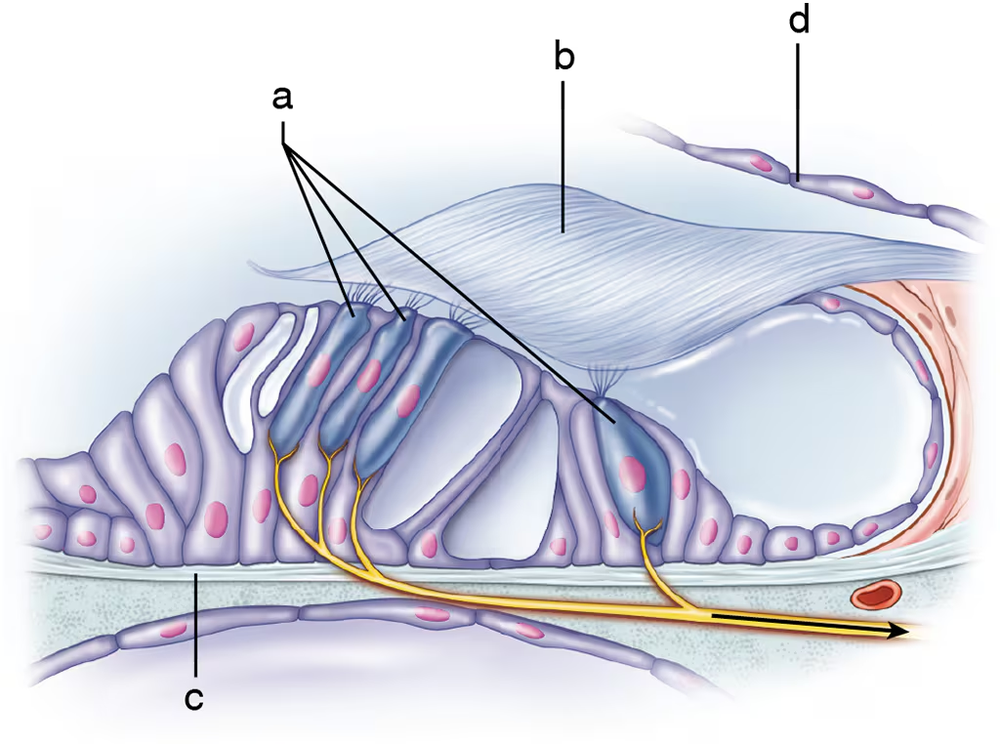
Movement of which structure triggers the bending of hairs of the hair cells in the spiral organ of Corti?
Illustration of the spiral organ of Corti, showing hair cells and their connections to auditory nerve fibers.

Verified step by step guidance
1
Understand the anatomy of the spiral organ of Corti: The spiral organ of Corti is located within the cochlea of the inner ear and is responsible for converting sound vibrations into electrical signals. It contains hair cells that are sensitive to mechanical movement.
Identify the structures involved in sound transmission: Sound waves cause vibrations in the tympanic membrane, which are transmitted through the ossicles (malleus, incus, stapes) to the oval window. These vibrations create waves in the perilymph and endolymph fluids within the cochlea.
Focus on the basilar membrane: The movement of the basilar membrane, which is part of the cochlear duct, triggers the bending of the hairs (stereocilia) on the hair cells. The basilar membrane vibrates in response to sound waves, and its movement is frequency-specific.
Examine the role of the tectorial membrane: The stereocilia of the hair cells are embedded in or closely associated with the tectorial membrane. Movement of the basilar membrane causes the stereocilia to bend against the tectorial membrane, initiating the mechanical-to-electrical signal transduction process.
Review the options provided in the question: Based on the anatomy and physiology of the spiral organ of Corti, determine which structure(s) (e.g., basilar membrane, tectorial membrane) are responsible for triggering the bending of the hairs on the hair cells.

Verified video answer for a similar problem:

This video solution was recommended by our tutors as helpful for the problem above.
Video duration:
4m
Was this helpful?

Key Concepts

Here are the essential concepts you must grasp in order to answer the question correctly.

Spiral Organ of Corti

The Spiral Organ of Corti, located within the cochlea of the inner ear, is the sensory organ responsible for converting sound vibrations into neural signals. It contains hair cells that are essential for hearing, and these cells are stimulated by the movement of fluid within the cochlea, which is caused by sound waves.
Recommended video:
Guided course
05:04
The Levels of Organization

Hair Cells

Hair cells are specialized sensory cells found in the inner ear that play a crucial role in the auditory and vestibular systems. They have tiny hair-like projections called stereocilia that bend in response to fluid movement, leading to the generation of electrical signals that are sent to the brain, allowing for the perception of sound.
Recommended video:
07:02
Other Epidermal Cells

Basilar Membrane

The basilar membrane is a flexible structure within the cochlea that supports the hair cells of the Organ of Corti. When sound waves enter the cochlea, they create pressure waves in the fluid, causing the basilar membrane to move. This movement is what ultimately triggers the bending of the hair cells' stereocilia, initiating the process of hearing.
Recommended video:
06:49
Biological Membranes