Pearson+ LogoPearson+ Logo
Ch. 1 - Can Science Cure the Common Cold?
Belk, Maier - Biology: Science for Life 6th Edition
Belk, Maier6th EditionBiology: Science for LifeISBN: 9780135214084Not the one you use?Change textbook
Chapter 1, Problem 2

Which of the following is an example of inductive reasoning?
a. All cows eat grass.
b. My cow eats grass and my neighbor's cow eats grass; therefore, all cows probably eat grass.
c. If all cows eat grass, when I examine a random sample of all the cows in Minnesota, I will find that all of them eat grass.
d. Cows may or may not eat grass, depending on the type of farm where they live.

Verified step by step guidance
1
Step 1: Understand the concept of inductive reasoning. Inductive reasoning involves making generalizations based on specific observations or evidence. It starts with specific instances and moves toward a broader generalization or conclusion.
Step 2: Analyze each option to determine if it fits the definition of inductive reasoning. Look for a statement that begins with specific observations and concludes with a generalization.
Step 3: Evaluate option (a): 'All cows eat grass.' This is a general statement and does not involve reasoning from specific observations, so it is not an example of inductive reasoning.
Step 4: Evaluate option (b): 'My cow eats grass and my neighbor's cow eats grass; therefore, all cows probably eat grass.' This starts with specific observations (my cow and my neighbor's cow eating grass) and concludes with a generalization (all cows probably eat grass). This fits the definition of inductive reasoning.
Step 5: Evaluate options (c) and (d): Option (c) involves deductive reasoning, as it starts with a general statement and predicts specific outcomes. Option (d) is a conditional statement and does not involve reasoning from specific observations. Therefore, option (b) is the correct example of inductive reasoning.

Verified video answer for a similar problem:

This video solution was recommended by our tutors as helpful for the problem above.
Video duration:
1m
Was this helpful?

Key Concepts

Here are the essential concepts you must grasp in order to answer the question correctly.

Inductive Reasoning

Inductive reasoning is a logical process in which generalizations are made based on specific observations or examples. It involves drawing conclusions from patterns or trends observed in data, leading to broader generalizations. For instance, if several individual cows are observed eating grass, one might conclude that all cows likely eat grass, even though this conclusion is not guaranteed.
Recommended video:
Guided course
02:52
Introduction to Bacterial Plasmids

Deductive Reasoning

Deductive reasoning is the process of drawing specific conclusions from general principles or premises. It starts with a general statement or hypothesis and examines the possibilities to reach a specific, logical conclusion. For example, if it is stated that all cows eat grass, then observing a cow would lead to the conclusion that this particular cow eats grass, assuming the initial premise is true.
Recommended video:
Guided course
02:36
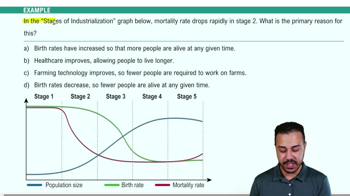
The Human Population Example 1

Sample and Generalization

In statistics and reasoning, a sample refers to a subset of a population used to make inferences about the whole. Generalization occurs when conclusions drawn from a sample are applied to the entire population. This process is central to inductive reasoning, as it relies on the assumption that the observed characteristics of the sample can be extended to the broader group, which can sometimes lead to inaccuracies if the sample is not representative.
Recommended video:
Guided course
02:31
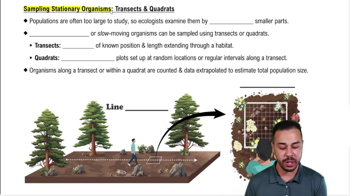
Sampling Stationary Organisms: Transects & Quadrats