Pearson+ LogoPearson+ Logo
Ch. 11 - Where Did We Come From?
Belk, Maier - Biology: Science for Life 6th Edition
Belk, Maier6th EditionBiology: Science for LifeISBN: 9780135214084Not the one you use?Change textbook
Chapter 11, Problem 3

Describe three ways that evolution can occur via genetic drift.

Verified step by step guidance
1
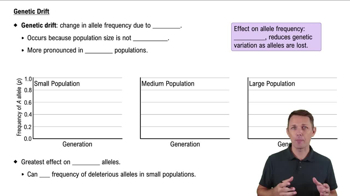
Understand the concept of genetic drift: Genetic drift is a mechanism of evolution that involves random changes in the frequency of alleles (different versions of a gene) within a population. This process occurs independently of natural selection and can lead to significant evolutionary changes, especially in small populations.
Founder Effect: This occurs when a new population is established by a very small number of individuals from a larger population. This small group may not have the same genetic makeup as the original population, leading to a shift in allele frequencies purely by chance. Over generations, these changes can become more pronounced, leading to evolutionary changes.
Bottleneck Effect: This happens when a large population is drastically reduced in size due to a sudden, random event (such as a natural disaster). The surviving population's genetic structure may not represent that of the original population. As a result, certain alleles may become overrepresented or underrepresented, leading to genetic drift.
Random Mating Failures: In small populations, if individuals do not mate randomly and instead mate with relatives (inbreeding), it can lead to changes in allele frequencies. This is because relatives are more likely to share similar alleles, increasing the chances of certain alleles becoming more common in the population than they would be by chance alone.
Understand the implications: Genetic drift can lead to reduced genetic variation within a population, which can affect the population's ability to adapt to new environmental challenges. It can also lead to the fixation or loss of alleles, which can have significant evolutionary consequences.

Verified video answer for a similar problem:

This video solution was recommended by our tutors as helpful for the problem above.
Video duration:
3m
Was this helpful?

Key Concepts

Here are the essential concepts you must grasp in order to answer the question correctly.

Genetic Drift

Genetic drift is a mechanism of evolution that refers to random changes in allele frequencies within a population. It occurs due to chance events that can cause certain alleles to become more or less common, independent of natural selection. This phenomenon is particularly significant in small populations, where random events can have a larger impact on the genetic makeup of the population.
Recommended video:
05:06
Genetic Drift

Bottleneck Effect

The bottleneck effect is a specific type of genetic drift that occurs when a population undergoes a dramatic reduction in size due to environmental events or human activities. This reduction can lead to a loss of genetic diversity, as only a small number of individuals contribute to the gene pool. The surviving population may have different allele frequencies compared to the original population, which can significantly alter the evolutionary trajectory.
Recommended video:
Guided course
04:52
Coriolis Effect Curves Prevailing Winds

Founder Effect

The founder effect is another form of genetic drift that occurs when a small group of individuals establishes a new population in a different location. This small founding population may carry only a limited genetic variation from the original population, leading to different allele frequencies. As the new population grows, the genetic characteristics of the founders can have a lasting impact on the population's evolution, often resulting in reduced genetic diversity.
Recommended video:
Guided course
04:52
Coriolis Effect Curves Prevailing Winds