Pearson+ LogoPearson+ Logo
Ch. 5 - Life in the Greenhouse
Belk, Maier - Biology: Science for Life 6th Edition
Belk, Maier6th EditionBiology: Science for LifeISBN: 9780135214084Not the one you use?Change textbook
Chapter 5, Problem 1

Add labels to the figure that follows, which illustrates the product and reactants of photosynthesis and the relationship between its light reactions and light-independent reactions. Diagram of a chloroplast showing light reactions, ATP, and reactants CO2 and O2.

Verified step by step guidance
1
Identify the main components involved in photosynthesis: the chloroplast, thylakoid, stroma, light energy, CO2, O2, ATP, and NADP+.
Label the thylakoid as the site where light-dependent reactions occur, capturing light energy to produce ATP and NADPH.
Label the stroma as the site where light-independent reactions (Calvin cycle) occur, using ATP and NADPH to convert CO2 into glucose.
Indicate the input of light energy into the thylakoid and the production of O2 as a byproduct of the light-dependent reactions.
Show the flow of ATP and NADPH from the thylakoid to the stroma, where they are used in the light-independent reactions to fix CO2 into organic molecules.

Verified video answer for a similar problem:

This video solution was recommended by our tutors as helpful for the problem above.
Video duration:
1m
Was this helpful?

Key Concepts

Here are the essential concepts you must grasp in order to answer the question correctly.

Photosynthesis

Photosynthesis is the biochemical process by which green plants, algae, and some bacteria convert light energy into chemical energy, specifically glucose. This process occurs primarily in chloroplasts and involves two main stages: the light-dependent reactions and the light-independent reactions (Calvin cycle). The overall equation for photosynthesis can be summarized as 6CO2 + 6H2O + light energy → C6H12O6 + 6O2.
Recommended video:
Guided course
05:58
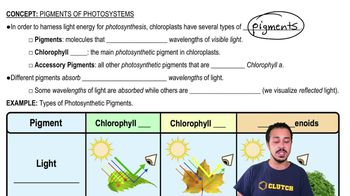
Pigments of Photosynthesis

Light-dependent Reactions

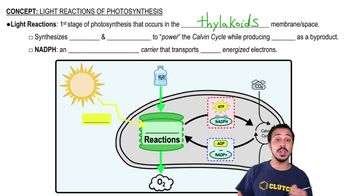
Light-dependent reactions occur in the thylakoid membranes of chloroplasts and require light to produce ATP and NADPH. During these reactions, light energy is absorbed by chlorophyll, leading to the splitting of water molecules (photolysis), which releases oxygen as a byproduct. The energy captured is then used to convert ADP and NADP+ into their energized forms, ATP and NADPH, which are essential for the subsequent light-independent reactions.
Recommended video:
Guided course
04:06
Light Reactions of Photosynthesis

Light-independent Reactions (Calvin Cycle)

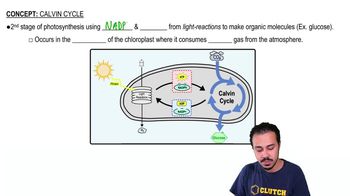
The light-independent reactions, also known as the Calvin cycle, take place in the stroma of chloroplasts and do not require light directly. Instead, they utilize ATP and NADPH produced in the light-dependent reactions to convert carbon dioxide (CO2) into glucose through a series of enzymatic reactions. This cycle is crucial for synthesizing organic compounds that serve as energy sources for the plant and, ultimately, for other organisms in the ecosystem.
Recommended video: