
Ch. 1 - Functions
Briggs - Calculus: Early Transcendentals 3rd Edition
Briggs3rd EditionCalculus: Early TranscendentalsISBN: 9780136847243Not the one you use?Change textbook
Chapter 1, Problem 75

Evaluating inverse trigonometric functions Without using a calculator, evaluate the following expressions.
tan13\(\tan\)^{-1}\(\sqrt\)3

Verified step by step guidance
1
Understand that \( \tan^{-1}(x) \) represents the angle whose tangent is \( x \). Therefore, \( \tan^{-1}(\sqrt{3}) \) is the angle whose tangent is \( \sqrt{3} \).
Recall the special angles and their tangent values. The tangent of \( \frac{\pi}{3} \) (or 60 degrees) is \( \sqrt{3} \).
Since \( \tan^{-1}(\sqrt{3}) \) is asking for the angle whose tangent is \( \sqrt{3} \), and we know that \( \tan(\frac{\pi}{3}) = \sqrt{3} \), the angle is \( \frac{\pi}{3} \).
Verify that \( \frac{\pi}{3} \) is within the range of the inverse tangent function, which is \( \left(-\frac{\pi}{2}, \frac{\pi}{2}\right) \). Since \( \frac{\pi}{3} \) is within this range, it is a valid solution.
Conclude that \( \tan^{-1}(\sqrt{3}) = \frac{\pi}{3} \).

Verified video answer for a similar problem:

This video solution was recommended by our tutors as helpful for the problem above.
Video duration:
3m
Was this helpful?

Key Concepts

Here are the essential concepts you must grasp in order to answer the question correctly.

Inverse Trigonometric Functions

Inverse trigonometric functions, such as an^{-1} (arctan), are used to find the angle whose tangent is a given number. These functions are essential in calculus for solving problems involving angles and their relationships to sides in right triangles. Understanding their ranges and properties is crucial for evaluating expressions without a calculator.
Recommended video:
06:35
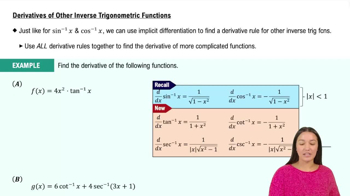
Derivatives of Other Inverse Trigonometric Functions

Special Angles in Trigonometry

Special angles, such as 30°, 45°, and 60°, have known sine, cosine, and tangent values that are often used in trigonometric evaluations. For example, an(60°) = √3, which directly relates to the expression an^{-1}√3. Familiarity with these angles allows for quick evaluations and simplifications in trigonometric problems.
Recommended video:
6:04
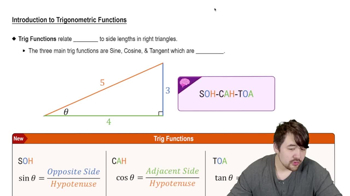
Introduction to Trigonometric Functions

Quadrants and Angle Values

The unit circle divides the plane into four quadrants, each corresponding to specific angle values and signs for sine, cosine, and tangent. Knowing which quadrant an angle lies in helps determine the correct value of inverse trigonometric functions. For instance, an^{-1}√3 corresponds to an angle in the first quadrant, where both sine and cosine are positive.
Recommended video:
5:30
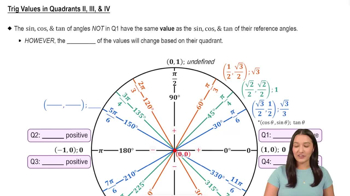
Trig Values in Quadrants II, III, & IV