


Angle to a particle (part 2) The figure in Exercise 81 shows the particle traveling away from the sensor, which may have influenced your solution (we expect you used the inverse sine function). Suppose instead that the particle approaches the sensor (see figure). How would this change the solution? Explain the differences in the two answers. <IMAGE>
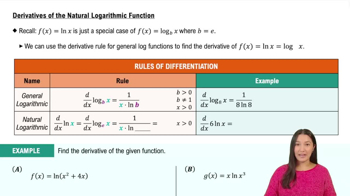
Find d/dx(ln√x²+1).
Verified step by step guidance
Verified video answer for a similar problem:
Key Concepts
Derivative
Natural Logarithm
Chain Rule
Consider the curve x=e^y. Use implicit differentiation to verify that dy/dx = e^-y and then find d²y/dx² .
75–86. Logarithmic differentiation Use logarithmic differentiation to evaluate f'(x).
f(x) = x^In x
At all times, the length of the long leg of a right triangle is 3 times the length x of the short leg of the triangle. If the area of the triangle changes with respect to time t, find equations relating the area A to x and dA/dt to dx/dt.
15–48. Derivatives Find the derivative of the following functions.
y = 10^In 2x
A projectile is fired vertically upward into the air; its position (in feet) above the ground after t seconds is given by the function s (t). For the following functions, use limits to determine the instantaneous velocity of the projectile at t = a seconds for the given value of a.
s(t) = -16t2 + 128t + 192; a = 2
