
Textbook Question
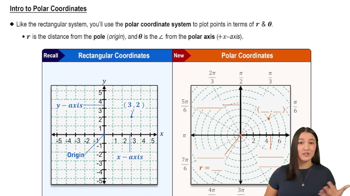
11–20. Slopes of tangent lines Find the slope of the line tangent to the following polar curves at the given points.
r = 4 + sin θ; (4, 0) and (3, 3π/2)
77
views

 Verified step by step guidance
 05:32
05:32 05:32
05:32 04:47
04:4711–20. Slopes of tangent lines Find the slope of the line tangent to the following polar curves at the given points.
r = 4 + sin θ; (4, 0) and (3, 3π/2)
31–38. Equations of parabolas Find an equation of the following parabolas. Unless otherwise specified, assume the vertex is at the origin.
A parabola with focus at (3, 0)
9–13. Graph the points with the following polar coordinates. Give two alternative representations of the points in polar coordinates.
(-4, 3π/2)
90–94. Focal chords A focal chord of a conic section is a line through a focus joining two points of the curve. The latus rectum is the focal chord perpendicular to the major axis of the conic. Prove the following properties.
The length of the latus rectum of a hyperbola centered at the origin is (2b²)/a = 2b√(1 - e²)
39–50. Equations of ellipses and hyperbolas Find an equation of the following ellipses and hyperbolas, assuming the center is at the origin.
A hyperbola with vertices (±4, 0) and foci (±6, 0)
63–74. Arc length of polar curves Find the length of the following polar curves.
{Use of Tech} The complete limaçon r=4−2cosθ