
Ch. 9 - Differential Equations
Briggs - Calculus: Early Transcendentals 3rd Edition
Briggs3rd EditionCalculus: Early TranscendentalsISBN: 9780136847243Not the one you use?Change textbook
Chapter 9, Problem 9.R.21a

Euler’s metho d Consider the initial value problem y′(t)=1/2y,y(0)=1. 
a. Use Euler’s method with Δt=0.1 to compute approximations to y(0.1) and y(0.2). 

Verified step by step guidance
1
Identify the differential equation and initial condition: \(y'(t) = \frac{1}{2} y\), with \(y(0) = 1\).
Recall Euler's method formula for approximating solutions: \(y_{n+1} = y_n + \Delta t \cdot f(t_n, y_n)\), where \(f(t, y) = y'(t)\).
Set the step size \(\Delta t = 0.1\) and start with \(t_0 = 0\), \(y_0 = 1\).
Calculate the approximation for \(y(0.1)\) using Euler's method: \(y_1 = y_0 + 0.1 \times \frac{1}{2} y_0\).
Calculate the approximation for \(y(0.2)\) similarly: \(y_2 = y_1 + 0.1 \times \frac{1}{2} y_1\).

Verified video answer for a similar problem:

This video solution was recommended by our tutors as helpful for the problem above.
Video duration:
3m
Was this helpful?

Key Concepts

Here are the essential concepts you must grasp in order to answer the question correctly.

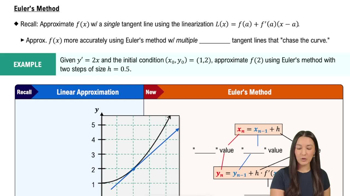
Euler's Method

Euler's method is a numerical technique to approximate solutions of first-order differential equations. It uses the slope at a known point to estimate the value of the function at the next point by stepping forward with a fixed step size Δt. This iterative process helps approximate values where exact solutions are difficult to find.
Recommended video:
07:33
Euler's Method

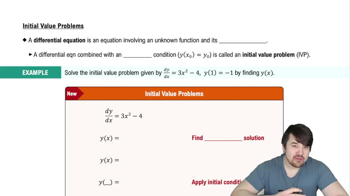
Initial Value Problem (IVP)

An initial value problem specifies a differential equation along with a starting value for the function at a given point. The solution to the IVP is a function that satisfies both the differential equation and the initial condition, providing a unique trajectory for the function's behavior over time.
Recommended video:
05:03
Initial Value Problems

Step Size (Δt) in Numerical Methods

The step size Δt determines the increments at which the solution is approximated in numerical methods like Euler's. Smaller step sizes generally yield more accurate approximations but require more computations, while larger step sizes reduce computational effort but may decrease accuracy and stability.
Recommended video:
07:33
Euler's Method
Related Practice