
Textbook Question
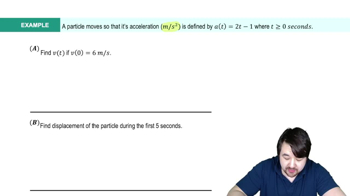
Acceleration A drag racer accelerates at a(t)=88 ft/s². Assume v(0)=0, s(0)=0, and t is measured in seconds.
e. How far has the racer traveled when it reaches a speed of 178 ft/s?
23
views

 Verified step by step guidance
 04:16
04:16
 08:56
08:56 05:59
05:59Acceleration A drag racer accelerates at a(t)=88 ft/s². Assume v(0)=0, s(0)=0, and t is measured in seconds.
e. How far has the racer traveled when it reaches a speed of 178 ft/s?
Bike race Theo and Sasha start at the same place on a straight road, riding bikes with the following velocities (measured in mi/hr). Assume t is measured in hours.
Theo: vT(t)=10, for t≥0
Sasha: vS(t)=15t, for 0≤t≤1, and vS(t)=15, for t>1
f. Suppose Sasha gives Theo a head start of 0.2 hr and the riders ride for 20 mi. Who wins the race?
Explain why or why not Determine whether the following statements are true and give an explanation or counterexample.
d. A particular marginal cost function has the property that it is positive and decreasing. The cost of increasing production from A units to 2A units is greater than the cost of increasing production from 2A units to 3A units.
Where do they meet? Kelly started at noon (t=0) riding a bike from Niwot to Berthoud, a distance of 20 km, with velocity v(t) = 15 / (t + 1)² (decreasing because of fatigue). Sandy started at noon (t=0) riding a bike in the opposite direction from Berthoud to Niwot with velocity u(t) = 20 / (t + 1)² (also decreasing because of fatigue). Assume distance is measured in kilometers and time is measured in hours.
d. More generally, if the riders’ speeds are v(t)=A(t+1)² and u(t)=B(t+1)² and the distance between the towns is D, what conditions on A, B, and D must be met to ensure that the riders will pass each other?
Compressing and stretching a spring Suppose a force of 30 N is required to stretch and hold a spring 0.2 m from its equilibrium position.
d. How much additional work is required to stretch the spring 0.2m if it has already been stretched 0.2m from its equilibrium position?