
Average value of the derivative Suppose ƒ ' is a continuous function for all real numbers. Show that the average value of the derivative on an interval [a, b] is ƒ⁻' = (ƒ(b) ―ƒ(a))/ (b―a) . Interpret this result in terms of secant lines.
General results Evaluate the following integrals in which the function ƒ is unspecified. Note that ƒ⁽ᵖ⁾ is the pth derivative of ƒ and ƒᵖ is the pth power of ƒ. Assume ƒ and its derivatives are continuous for all real numbers.
∫ (5 ƒ³ (𝓍) + 7ƒ² (𝓍) + ƒ (𝓍 )) ƒ'(𝓍) d𝓍
Verified step by step guidance
Verified video answer for a similar problem:
Key Concepts
Integration by Substitution
Notation and Interpretation of Derivatives and Powers
Properties of Continuous Functions and Their Derivatives
{Use of Tech} Areas of regions Find the area of the region 𝑅 bounded by the graph of ƒ and the 𝓍-axis on the given interval. Graph ƒ and show the region 𝑅.
ƒ(𝓍) = 2 ― |𝓍| on [ ― 2 , 4]
The linear function ƒ(𝓍) = 3 ― 𝓍 is decreasing on the interval [0, 3]. Is its area function for ƒ (with left endpoint 0) increasing or decreasing on the interval [0, 3]? Draw a picture and explain.
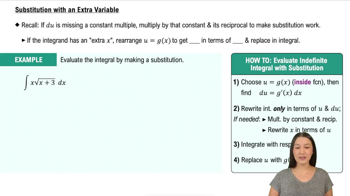
Variations on the substitution method Evaluate the following integrals.
∫ y²/(y + 1)⁴ dy
Approximating displacement The velocity of an object is given by the following functions on a specified interval. Approximate the displacement of the object on this interval by subdividing the interval into n subintervals. Use the left endpoint of each subinterval to compute the height of the rectangles.
v = 2t + 1(m/s), for 0 ≤ t ≤ 8 ; n = 2
Derivatives of integrals Simplify the following expressions.
d/d𝓍 ∫₀ˣ (√1 + t²) dt (Hint: ∫ˣ₋ₓ (√1 + t²) dt = ∫⁰₋ₓ (√1 + t²) dt + ∫ˣ₋ₓ (√1 + t²) dt ) .
