Ch. 1 - Functions
Briggs - Calculus: Early Transcendentals 3rd Edition
Briggs3rd EditionCalculus: Early TranscendentalsISBN: 9780136847243Not the one you use?Change textbook
Chapter 1, Problem 3

Decide whether ff, gg, or both represent one-to-one functions. <IMAGE>

Verified step by step guidance
1
Understand the definition of a one-to-one function: A function is one-to-one if and only if every element of the function's range is mapped to by exactly one element of its domain. This means that no two different inputs should produce the same output.
To determine if a function is one-to-one, you can use the Horizontal Line Test. If any horizontal line intersects the graph of the function more than once, the function is not one-to-one.
Examine the graph of function f. Check if there are any horizontal lines that intersect the graph at more than one point. If such lines exist, f is not one-to-one.
Examine the graph of function g. Similarly, check for horizontal lines that intersect the graph at more than one point. If such lines exist, g is not one-to-one.
Conclude based on your observations: If neither graph is intersected more than once by any horizontal line, both functions are one-to-one. If only one graph passes the test, only that function is one-to-one. If both fail, neither is one-to-one.

Verified video answer for a similar problem:

This video solution was recommended by our tutors as helpful for the problem above.
Video duration:
2m
Was this helpful?

Key Concepts

Here are the essential concepts you must grasp in order to answer the question correctly.

One-to-One Function

A one-to-one function, or injective function, is a type of function where each output is produced by exactly one input. This means that if f(a) = f(b), then a must equal b. To determine if a function is one-to-one, one can use the horizontal line test: if any horizontal line intersects the graph of the function more than once, the function is not one-to-one.
Recommended video:
05:50
One-Sided Limits

Function Notation

Function notation is a way to represent functions in mathematics, typically using symbols like f(x) or g(x). It allows for clear communication of the relationship between inputs and outputs. Understanding function notation is essential for analyzing and manipulating functions, as it provides a concise way to express the operations performed on the input values.
Recommended video:
04:22
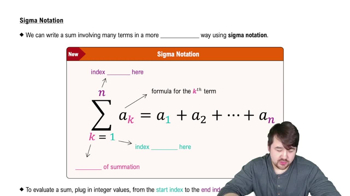
Sigma Notation

Graphical Analysis

Graphical analysis involves examining the graph of a function to understand its properties, such as continuity, limits, and one-to-one behavior. By visualizing the function, one can identify key features like intercepts, asymptotes, and the overall shape, which aids in determining whether the function meets specific criteria, such as being one-to-one.
Recommended video:
05:02
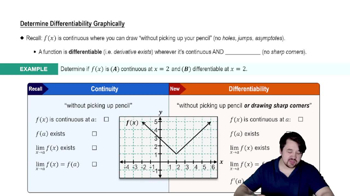
Determining Differentiability Graphically