Ch. 8 - Integration Techniques
Briggs - Calculus: Early Transcendentals 3rd Edition
Briggs3rd EditionCalculus: Early TranscendentalsISBN: 9780136847243Not the one you use?Change textbook
Chapter 8, Problem 8.9.88b

88. Incorrect Calculation
b. Evaluate ∫(from -1 to 1) dx/x or show that the integral does not exist.

Verified step by step guidance
1
Identify the integral to evaluate: \(\int_{-1}^{1} \frac{dx}{x}\). Notice that the integrand \(\frac{1}{x}\) is undefined at \(x=0\), which lies within the interval of integration.
Since the function is not defined at \(x=0\), split the integral into two improper integrals at the point of discontinuity: \(\int_{-1}^{1} \frac{dx}{x} = \int_{-1}^{0} \frac{dx}{x} + \int_{0}^{1} \frac{dx}{x}\).
Rewrite each integral as a limit to handle the improper nature: \(\int_{-1}^{0} \frac{dx}{x} = \lim_{t \to 0^-} \int_{-1}^{t} \frac{dx}{x}\) and \(\int_{0}^{1} \frac{dx}{x} = \lim_{s \to 0^+} \int_{s}^{1} \frac{dx}{x}\).
Evaluate the antiderivative of \(\frac{1}{x}\), which is \(\ln|x|\), and apply it to each integral before taking the limits.
Examine the behavior of the limits as \(t \to 0^-\) and \(s \to 0^+\) to determine if the integrals converge or diverge. If either limit diverges, conclude that the original integral does not exist.

Verified video answer for a similar problem:

This video solution was recommended by our tutors as helpful for the problem above.
Video duration:
2m
Was this helpful?

Key Concepts

Here are the essential concepts you must grasp in order to answer the question correctly.

Improper Integrals

An improper integral occurs when the integrand is undefined or unbounded within the interval of integration. In this problem, the function 1/x is undefined at x = 0, which lies between -1 and 1, making the integral improper and requiring special evaluation methods.
Recommended video:
11:11
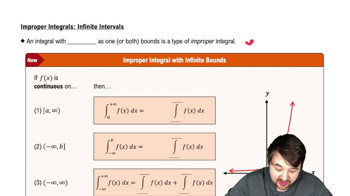
Improper Integrals: Infinite Intervals

Cauchy Principal Value

The Cauchy principal value is a method to assign a finite value to certain improper integrals that are otherwise divergent. For ∫ from -1 to 1 of 1/x dx, the principal value considers symmetric limits approaching zero from both sides, potentially yielding a finite result despite the singularity.
Recommended video:
06:37
Average Value of a Function

Non-Existence of the Integral

If the limits of the integral do not converge to a finite number due to the singularity, the integral is said not to exist in the usual sense. Since 1/x has an infinite discontinuity at zero, the integral from -1 to 1 diverges unless interpreted as a principal value.
Recommended video:
03:07
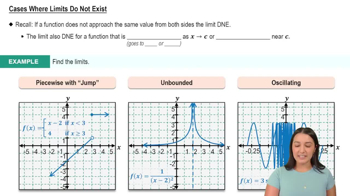
Cases Where Limits Do Not Exist
Related Practice
Textbook Question

58. Two Methods Evaluate ∫(from 0 to π/3) sin(x) · ln(cos(x)) dx in the following two ways:

b. Use substitution.

66
views

Textbook Question

Let L(c) be the length of the parabola f(x) = x² from x = 0 to x = c, where c ≥ 0 is a constant.

b. Is L concave up or concave down on [0, ∞)?

35
views
Textbook Question

The Eiffel Tower Property Let R be the region between the curves y = e^(-c·x) and y = -e^(-c·x) on the interval [a, ∞), where a ≥ 0 and c > 0.

The center of mass of R is located at (x̄, 0), where x̄ = [∫(a to ∞) x·e^(-c·x) dx] / [∫(a to ∞) e^(-c·x) dx]

(The profile of the Eiffel Tower is modeled by these two exponential curves; see the Guided Project ""The exponential Eiffel Tower"")

b. With a = 0 and c = 2, find the equations of the lines tangent to both curves at x = 0

58
views
Textbook Question

Computing areas On the interval [0,2], the graphs of f(x)=x²/3 and g(x)=x²(9−x²)^(-1/2) have similar shapes.

b. Find the area of the region bounded by the graph of g and the x-axis on the interval [0,2].

39
views
Textbook Question

{Use of Tech} Powers of sine and cosine It can be shown that

∫ from 0 to π/2 of sinⁿx dx = ∫ from 0 to π/2 of cosⁿx dx =

{

[1·3·5···(n-1)]/[2·4·6···n] · π/2 if n ≥ 2 is even

[2·4·6···(n-1)]/[3·5···n] if n ≥ 3 is odd

}

b. Evaluate the integrals with n = 10 and confirm the result.

99
views
Textbook Question

66–71. {Use of Tech} Estimating error Refer to Theorem 8.1 in the following exercises.

71. Let f(x) = √(sin x).

b. Find an upper bound on the absolute error in the estimate from part (a) using Theorem 8.1. (Hint: |f''''(x)| ≤ 1 on [1,2].)

36
views