
Ch. 1 - Functions
Hass - Thomas' Calculus 15th Edition
Hass15th EditionThomas' CalculusISBN: 9780137616077Not the one you use?Change textbook
Chapter 1, Problem 1.3.50

Using the Half-Angle Formulas


Find the function values in Exercises 47–50.


sin² 3π/8

Verified step by step guidance
1
First, recognize that the half-angle formulas are useful for finding the sine or cosine of an angle that is half of a given angle. The half-angle formula for sine is: \( \sin^2 \theta = \frac{1 - \cos(2\theta)}{2} \).
In this problem, we need to find \( \sin^2 \frac{3\pi}{8} \). Notice that \( \frac{3\pi}{8} \) is half of \( \frac{3\pi}{4} \). Therefore, we can use the half-angle formula for sine.
Substitute \( \theta = \frac{3\pi}{8} \) into the half-angle formula: \( \sin^2 \frac{3\pi}{8} = \frac{1 - \cos(\frac{3\pi}{4})}{2} \).
Next, find \( \cos(\frac{3\pi}{4}) \). The angle \( \frac{3\pi}{4} \) is in the second quadrant where cosine is negative. The reference angle is \( \frac{\pi}{4} \), and \( \cos(\frac{\pi}{4}) = \frac{\sqrt{2}}{2} \). Therefore, \( \cos(\frac{3\pi}{4}) = -\frac{\sqrt{2}}{2} \).
Substitute \( \cos(\frac{3\pi}{4}) = -\frac{\sqrt{2}}{2} \) back into the formula: \( \sin^2 \frac{3\pi}{8} = \frac{1 - (-\frac{\sqrt{2}}{2})}{2} \). Simplify the expression to find the value of \( \sin^2 \frac{3\pi}{8} \).

Verified video answer for a similar problem:

This video solution was recommended by our tutors as helpful for the problem above.
Video duration:
3m
Was this helpful?

Key Concepts

Here are the essential concepts you must grasp in order to answer the question correctly.

Half-Angle Formulas

Half-angle formulas are trigonometric identities that express the sine and cosine of half an angle in terms of the sine and cosine of the original angle. For example, the sine half-angle formula is given by sin(θ/2) = √((1 - cos(θ))/2). These formulas are particularly useful for simplifying expressions involving angles that are not easily computable.
Recommended video:
Guided course
5:04
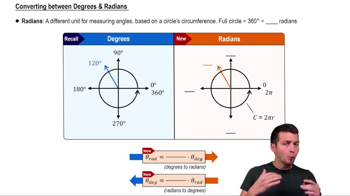
Converting between Degrees & Radians

Trigonometric Functions

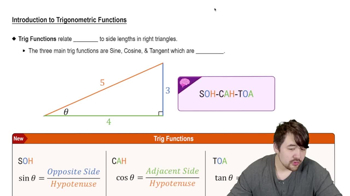
Trigonometric functions, such as sine, cosine, and tangent, relate the angles of a triangle to the lengths of its sides. They are fundamental in calculus and are used to model periodic phenomena. Understanding how to evaluate these functions at specific angles, including those expressed in radians, is essential for solving problems involving trigonometric identities.
Recommended video:
6:04
Introduction to Trigonometric Functions

Radians and Degrees

Radians and degrees are two units for measuring angles. Radians are based on the radius of a circle, where one radian is the angle subtended by an arc equal in length to the radius. Understanding the conversion between these units is crucial, especially when working with trigonometric functions, as many calculus problems use radians for angle measurements.
Recommended video:
Guided course
5:04
Converting between Degrees & Radians