Ch. 2 - Limits
Briggs - Calculus: Early Transcendentals 3rd Edition
Briggs3rd EditionCalculus: Early TranscendentalsISBN: 9780136847243Not the one you use?Change textbook
Chapter 2, Problem 2.5.50

Determine limxf(x)\(\lim\)_{x\(\rightarrow\]\infty\)}f\(\left\)(x\(\right\)) and limxf(x)\(\lim\)_{x\(\rightarrow\)-\(\infty\)}f\(\left\)(x\(\right\)) for the following functions. Then give the horizontal asymptotes of ff (if any).


f(x)=4x(3x9x2+1)f\(\left\)(x\(\right\))=4x\(\left\)(3x-\(\sqrt{9x^2+1}\]\right\))

Verified step by step guidance
1
First, let's analyze the function f(x) = 4x(3x - \(\sqrt{9x^2 + 1}\)). We need to find the limits as x approaches infinity and negative infinity.
To find \(\lim\)_{x \(\to\) \(\infty\)} f(x), factor out x from the square root in the expression \(\sqrt{9x^2 + 1}\). This gives us \(\sqrt{x^2(9 + \frac{1}{x^2}\))} = x\(\sqrt{9 + \frac{1}{x^2}\)}.
Rewrite the function as f(x) = 4x(3x - x\(\sqrt{9 + \frac{1}{x^2}\)}) = 4x^2(3 - \(\sqrt{9 + \frac{1}{x^2}\)}).
As x approaches infinity, \(\frac{1}{x^2}\) approaches 0, so \(\sqrt{9 + \frac{1}{x^2}\)} approaches \(\sqrt{9}\) = 3. Therefore, the expression 3 - \(\sqrt{9 + \frac{1}{x^2}\)} approaches 0.
Thus, \(\lim\)_{x \(\to\) \(\infty\)} f(x) = 4x^2 \(\cdot\) 0 = 0. Similarly, for \(\lim\)_{x \(\to\) -\(\infty\)} f(x), the same reasoning applies, leading to the conclusion that the horizontal asymptote is y = 0.

Verified video answer for a similar problem:

This video solution was recommended by our tutors as helpful for the problem above.
Video duration:
9m
Was this helpful?

Key Concepts

Here are the essential concepts you must grasp in order to answer the question correctly.

Limits at Infinity

Limits at infinity describe the behavior of a function as the input approaches positive or negative infinity. This concept is crucial for understanding how functions behave in extreme cases, allowing us to determine horizontal asymptotes. For example, if the limit of f(x) as x approaches infinity is a finite number, it indicates that the function approaches a horizontal line at that value.
Recommended video:
03:07
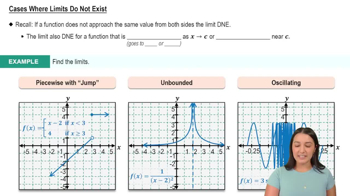
Cases Where Limits Do Not Exist

Horizontal Asymptotes

Horizontal asymptotes are lines that a graph approaches as x approaches infinity or negative infinity. They provide insight into the end behavior of a function. If a function has a horizontal asymptote at y = L, it means that as x becomes very large or very small, the function values get closer to L, indicating stability in the function's output at extreme values.
Recommended video:
5:50
Asymptotes of Hyperbolas

Dominant Terms in Functions

In polynomial and rational functions, the dominant term is the term with the highest degree, which significantly influences the function's behavior as x approaches infinity or negative infinity. Identifying the dominant term helps simplify the limit calculations, as lower-degree terms become negligible in comparison. For instance, in the function f(x) = 4x(3x - √(9x² + 1)), the dominant term is 12x², which guides the limit evaluation.
Recommended video:
05:44
Divergence Test (nth Term Test)