

Ch. 3 - Derivatives
Briggs - Calculus: Early Transcendentals 3rd Edition
Briggs3rd EditionCalculus: Early TranscendentalsISBN: 9780136847243Not the one you use?Change textbook
Chapter 3, Problem 3.6.25c

Suppose a stone is thrown vertically upward from the edge of a cliff on Earth with an initial velocity of 64 ft/s from a height of 32 ft above the ground. The height (in feet) of the stone above the ground t seconds after it is thrown is s(t) = -16t²+64t+32.
c. What is the height of the stone at the highest point?

Verified step by step guidance
1
To find the height of the stone at the highest point, we need to determine when the stone reaches its maximum height. This occurs at the vertex of the parabolic function s(t) = -16t² + 64t + 32.
The vertex of a parabola given by the equation s(t) = at² + bt + c can be found using the formula t = -b/(2a). Here, a = -16 and b = 64.
Substitute the values of a and b into the formula: t = -64/(2 * -16). Simplify this expression to find the time t at which the stone reaches its maximum height.
Once you have the value of t, substitute it back into the original height function s(t) = -16t² + 64t + 32 to find the height of the stone at this time.
Calculate s(t) using the value of t found in the previous step to determine the maximum height of the stone above the ground.

Verified video answer for a similar problem:

This video solution was recommended by our tutors as helpful for the problem above.
Video duration:
4m
Was this helpful?

Key Concepts

Here are the essential concepts you must grasp in order to answer the question correctly.

Quadratic Functions

The height of the stone is modeled by a quadratic function, s(t) = -16t² + 64t + 32. Quadratic functions are polynomial functions of degree two, characterized by their parabolic shape. The coefficients determine the direction of the parabola and its vertex, which represents the maximum or minimum point of the function.
Recommended video:
6:04
Introduction to Polynomial Functions

Vertex of a Parabola

The highest point of a parabola represented by a quadratic function occurs at its vertex. For a function in the form s(t) = at² + bt + c, the t-coordinate of the vertex can be found using the formula t = -b/(2a). This point gives the time at which the stone reaches its maximum height, which is essential for solving the problem.
Recommended video:
7:42
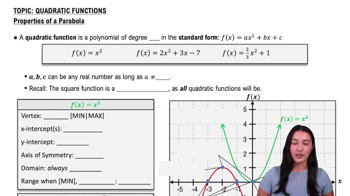
Properties of Parabolas

Maximizing Height

To find the maximum height of the stone, we substitute the t-coordinate of the vertex back into the height function s(t). This process allows us to determine the maximum value of the function, which corresponds to the highest point the stone reaches during its flight. Understanding this step is crucial for answering the question accurately.
Recommended video:
04:18
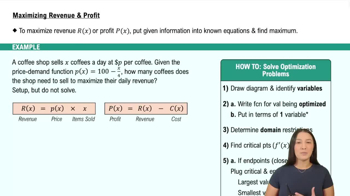
Maximizing Profit & Revenue
Related Practice
Textbook Question

{Use of Tech} Spring runoff The flow of a small stream is monitored for 90 days between May 1 and August 1. The total water that flows past a gauging station is given by v(t) = <matrix 2x2> where V is measured in cubic feet and t is measured in days, with t=0 corresponding to May 1.

c. Describe the flow of the stream over the 3-month period. Specifically, when is the flow rate a maximum?

218
views
Textbook Question

Derivatives from a graph If possible, evaluate the following derivatives using the graphs of f and f'. <IMAGE>

c. (f^-1)'(f(2))

382
views
Textbook Question

Highway travel A state patrol station is located on a straight north-south freeway. A patrol car leaves the station at 9:00 A.M. heading north with position function s = f(t) that gives its location in miles t hours after 9:00 A.M. (see figure). Assume s is positive when the car is north of the patrol station. <IMAGE>

c. Find the average velocity of the car over the interval [1.75, 2.25]. Estimate the velocity of the car at 11:00 A.M. and determine the direction in which the patrol car is moving.

239
views
Textbook Question

97–100. Logistic growth Scientists often use the logistic growth function P(t) = P₀K / P₀+(K−P₀)e^−r₀t to model population growth, where P₀ is the initial population at time t=0, K is the carrying capacity, and r₀ is the base growth rate. The carrying capacity is a theoretical upper bound on the total population that the surrounding environment can support. The figure shows the sigmoid (S-shaped) curve associated with a typical logistic model. <IMAGE>


{Use of Tech} Gone fishing When a reservoir is created by a new dam, 50 fish are introduced into the reservoir, which has an estimated carrying capacity of 8000 fish. A logistic model of the fish population is P(t) = 400,000 / 50+7950e^−0.5t, where t is measured in years.


c. How fast (in fish per year) is the population growing at t=0? At t=5?

200
views
Textbook Question

Vibrations of a spring Suppose an object of mass m is attached to the end of a spring hanging from the ceiling. The mass is at its equilibrium position y=0y=0 when the mass hangs at rest. Suppose you push the mass to a position y0y_0 units above its equilibrium position and release it. As the mass oscillates up and down (neglecting any friction in the system), the position y of the mass after t seconds is y=y0cos(tkm)y=y_0\(\cos\]\left\)(t\(\sqrt{\frac{k}{m}\)}\(\right\)), where k>0k>0 is a constant measuring the stiffness of the spring (the larger the value of kk, the stiffer the spring) and yy is positive in the upward direction.

Use equation (4) to answer the following questions.

c. How would the velocity be affected if the experiment were repeated with a spring having four times the stiffness (kk is increased by a factor of 44)?

394
views
Textbook Question

Finding derivatives from a table Find the values of the following derivatives using the table. <IMAGE>


c. d/dx ((f(x)g(x)) |x=3

258
views