Ch. 2 - Limits
Briggs - Calculus: Early Transcendentals 3rd Edition
Briggs3rd EditionCalculus: Early TranscendentalsISBN: 9780136847243Not the one you use?Change textbook
Chapter 2, Problem 2.5.39

Determine limxf(x)\(\lim\)_{x\(\rightarrow\]\infty\)}f\(\left\)(x\(\right\)) and limxf(x)\(\lim\)_{x\(\rightarrow\)-\(\infty\)}f\(\left\)(x\(\right\)) for the following functions. Then give the horizontal asymptotes of ff (if any).


f(x)=6x29x+83x2+2f\(\left\)(x\(\right\))=\(\frac{6x^2-9x+8}{3x^2+2}\)

Verified step by step guidance
1
Identify the degrees of the polynomials in the numerator and the denominator. Here, both the numerator and the denominator are quadratic polynomials with the highest degree term being x^2.
For limits at infinity, focus on the leading terms of the numerator and the denominator. The leading term in the numerator is 6x^2 and in the denominator is 3x^2.
Calculate the limit as x approaches infinity by dividing the leading coefficients: lim_{x→∞} f(x) = lim_{x→∞} (6x^2/3x^2) = 6/3 = 2.
Similarly, calculate the limit as x approaches negative infinity. Since the leading terms are the same, the limit will also be the same: lim_{x→-∞} f(x) = 2.
Since both limits as x approaches positive and negative infinity are equal to 2, the horizontal asymptote of the function f(x) is y = 2.

Verified video answer for a similar problem:

This video solution was recommended by our tutors as helpful for the problem above.
Video duration:
4m
Was this helpful?

Key Concepts

Here are the essential concepts you must grasp in order to answer the question correctly.

Limits at Infinity

Limits at infinity describe the behavior of a function as the input approaches positive or negative infinity. This concept is crucial for understanding how functions behave in extreme cases, allowing us to determine horizontal asymptotes. For example, if the limit of f(x) as x approaches infinity is a constant, it indicates that the function approaches that constant value, suggesting a horizontal asymptote.
Recommended video:
03:07
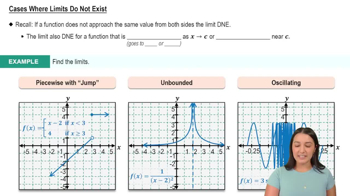
Cases Where Limits Do Not Exist

Horizontal Asymptotes

Horizontal asymptotes are lines that a graph approaches as x approaches infinity or negative infinity. They provide insight into the long-term behavior of a function. For rational functions, horizontal asymptotes can often be found by comparing the degrees of the numerator and denominator, which helps in predicting the function's end behavior.
Recommended video:
5:50
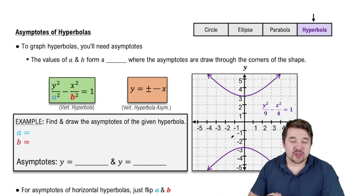
Asymptotes of Hyperbolas

Rational Functions

Rational functions are ratios of polynomials, expressed in the form f(x) = P(x)/Q(x), where P and Q are polynomials. Understanding the degrees of these polynomials is essential for analyzing limits and asymptotic behavior. In the given function, the degrees of the numerator and denominator will determine the horizontal asymptotes and the limits at infinity.
Recommended video:
6:04
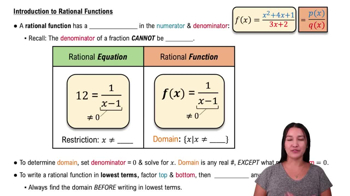
Intro to Rational Functions
Related Practice
Textbook Question

Sketch a graph of f and use it to make a conjecture about the values of f(a), lim x→a^−f(x),lim x→a^+f(x), and lim x→a f(x) or state that they do not exist.

f(x) = {√x if x<4

3 if x=4; a=4

x+1 if x>4

337
views

Textbook Question

Determine limxf(x)\(\lim\)_{x\(\rightarrow\]\infty\)}f\(\left\)(x\(\right\)) and limxf(x)\(\lim\)_{x\(\rightarrow\)-\(\infty\)}f\(\left\)(x\(\right\)) for the following functions. Then give the horizontal asymptotes of ff (if any).


f(x)=4x(3x9x2+1)f\(\left\)(x\(\right\))=4x\(\left\)(3x-\(\sqrt{9x^2+1}\]\right\))

348
views
Textbook Question

Sketch a possible graph of a function f that satisfies all of the given conditions. Be sure to identify all vertical and horizontal asymptotes.

f(1)=2f\(\left\)(-1\(\right\))=-2, f(1)=2f\(\left\)(1\(\right\))=2, f(0)=0f\(\left\)(0\(\right\))=0, limxf(x)=1{\(\displaystyle\[\lim\)_{x\(\to\]\infty\)}{f(x)=1}}, limxf(x)=1{\(\displaystyle\]\lim\)_{x\(\to\)-\(\infty\)}{f(x)=-1}}

521
views
Textbook Question

Consider the position function s(t) =−16t^2+100t representing the position of an object moving vertically along a line. Sketch a graph of s with the secant line passing through (0.5, s(0.5)) and (2, s(2)). Determine the slope of the secant line and explain its relationship to the moving object.

370
views
Textbook Question

Estimate the following limits using graphs or tables.

limh0ln(1+h)h{\(\displaystyle\]\lim\)_{h\(\to\)0}}\(\frac{\ln\left(1+h\right)}{h}\)

475
views
Textbook Question

Evaluate each limit and justify your answer. 

lim t→4 t−4 /√t−2

367
views