Ch. 4 - Applications of the Derivative
Briggs - Calculus: Early Transcendentals 3rd Edition
Briggs3rd EditionCalculus: Early TranscendentalsISBN: 9780136847243Not the one you use?Change textbook
Chapter 4, Problem 4.5.51

Viewing angles An auditorium with a flat floor has a large screen on one wall. The lower edge of the screen is 3 ft above eye level and the upper edge of the screen is 10 ft above eye level (see figure). How far from the screen should you stand to maximize your viewing angle? <IMAGE>

Verified step by step guidance
1
First, define the viewing angle θ as the angle subtended by the screen at the viewer's eye level. This angle can be expressed in terms of the distances from the viewer to the lower and upper edges of the screen.
Next, use trigonometry to express the viewing angle θ in terms of the distance x from the screen. The tangent of the angle θ can be expressed as the difference in height of the screen divided by the distance x: tan(θ) = (10 - 3) / x.
To maximize the viewing angle, you need to find the value of x that maximizes θ. This involves taking the derivative of θ with respect to x and setting it equal to zero to find critical points.
Calculate the derivative of tan(θ) with respect to x, which involves using the chain rule and the derivative of the tangent function. Set this derivative equal to zero to solve for x.
Finally, verify that the critical point found is indeed a maximum by using the second derivative test or analyzing the behavior of the function around the critical point.

Verified video answer for a similar problem:

This video solution was recommended by our tutors as helpful for the problem above.
Video duration:
12m
Was this helpful?

Key Concepts

Here are the essential concepts you must grasp in order to answer the question correctly.

Viewing Angle

The viewing angle is the angle formed between two lines drawn from the observer's eyes to the edges of an object, in this case, the screen. Maximizing this angle enhances the viewer's experience by allowing a broader perspective of the screen. Understanding how to calculate and optimize this angle is crucial for determining the ideal distance from the screen.
Recommended video:
8:22
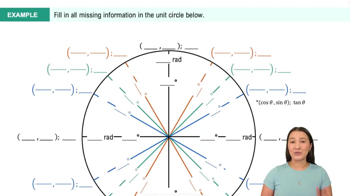
Trig Values in Quadrants II, III, & IV Example 2

Trigonometric Functions

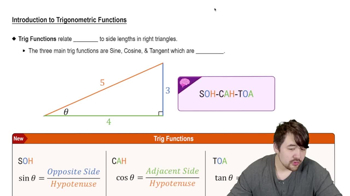
Trigonometric functions, such as tangent, sine, and cosine, relate the angles of a triangle to the lengths of its sides. In this scenario, the tangent function can be used to express the relationship between the height of the screen and the distance from the viewer to the screen. Mastery of these functions is essential for solving problems involving angles and distances.
Recommended video:
6:04
Introduction to Trigonometric Functions

Optimization

Optimization in calculus involves finding the maximum or minimum values of a function. In this context, we need to maximize the viewing angle by determining the optimal distance from the screen. This typically involves taking the derivative of the function representing the viewing angle and setting it to zero to find critical points.
Recommended video:
10:13
Intro to Applied Optimization: Maximizing Area