Ch. 2 - Limits and Continuity
Hass - Thomas' Calculus 15th Edition
Hass15th EditionThomas' CalculusISBN: 9780137616077Not the one you use?Change textbook
Chapter 2, Problem 2.48d

Horizontal and Vertical Asymptotes


Use limits to determine the equations for all horizontal asymptotes.
_________
/ x² + 9
d. y = / -------------
√ 9x² + 1

Verified step by step guidance
1
Identify the function for which we need to find the horizontal asymptotes: \( y = \frac{\sqrt{x^2 + 9}}{\sqrt{9x^2 + 1}} \).
To find horizontal asymptotes, evaluate the limit of the function as \( x \to \infty \) and \( x \to -\infty \).
Simplify the expression under the square roots by factoring out the highest power of \( x \) from both the numerator and the denominator. This involves rewriting \( \sqrt{x^2 + 9} \) as \( \sqrt{x^2(1 + \frac{9}{x^2})} = |x|\sqrt{1 + \frac{9}{x^2}} \) and \( \sqrt{9x^2 + 1} \) as \( \sqrt{x^2(9 + \frac{1}{x^2})} = |x|\sqrt{9 + \frac{1}{x^2}} \).
Substitute these simplified forms back into the original function: \( y = \frac{|x|\sqrt{1 + \frac{9}{x^2}}}{|x|\sqrt{9 + \frac{1}{x^2}}} \). Cancel out \( |x| \) from the numerator and the denominator.
Evaluate the limit of the simplified expression as \( x \to \infty \) and \( x \to -\infty \). The expression simplifies to \( \frac{\sqrt{1 + \frac{9}{x^2}}}{\sqrt{9 + \frac{1}{x^2}}} \), which approaches \( \frac{1}{3} \) as \( x \to \infty \) and \( x \to -\infty \). Thus, the horizontal asymptote is \( y = \frac{1}{3} \).

Verified video answer for a similar problem:

This video solution was recommended by our tutors as helpful for the problem above.
Video duration:
4m
Was this helpful?

Key Concepts

Here are the essential concepts you must grasp in order to answer the question correctly.

Limits

Limits are fundamental in calculus, representing the value that a function approaches as the input approaches a certain point. They are essential for analyzing the behavior of functions at specific points, particularly at infinity, which is crucial for determining asymptotes. Understanding limits allows us to evaluate the end behavior of rational functions and identify horizontal asymptotes.
Recommended video:
05:50
One-Sided Limits

Horizontal Asymptotes

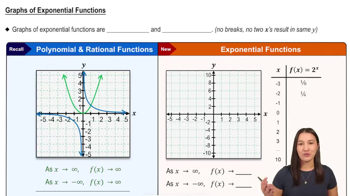
Horizontal asymptotes describe the behavior of a function as the input approaches infinity or negative infinity. They indicate the value that the function approaches in the horizontal direction, which can be determined using limits. For rational functions, horizontal asymptotes can often be found by comparing the degrees of the numerator and denominator.
Recommended video:
5:46
Graphs of Exponential Functions

Rational Functions

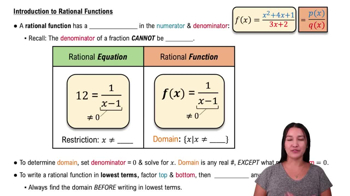
Rational functions are expressions formed by the ratio of two polynomials. They are significant in calculus for analyzing their limits and asymptotic behavior. The degrees of the polynomials in the numerator and denominator play a critical role in determining the existence and location of horizontal asymptotes, making it essential to understand their structure.
Recommended video:
6:04
Intro to Rational Functions