Ch. 1 - Functions
Briggs - Calculus: Early Transcendentals 3rd Edition
Briggs3rd EditionCalculus: Early TranscendentalsISBN: 9780136847243Not the one you use?Change textbook
Chapter 1, Problem 1.1.74

Simplify the difference quotient (ƒ(x)-ƒ(a)) / (x-a) for the following functions.
ƒ(x) = (1/x) - x²

Verified step by step guidance
1
First, identify the function ƒ(x) = (1/x) - x² and the point a. We need to find ƒ(a) by substituting a into the function: ƒ(a) = (1/a) - a².
Next, substitute ƒ(x) and ƒ(a) into the difference quotient formula: (ƒ(x) - ƒ(a)) / (x - a). This gives us: (((1/x) - x²) - ((1/a) - a²)) / (x - a).
Simplify the numerator by combining like terms: ((1/x) - (1/a)) - (x² - a²). Notice that (x² - a²) is a difference of squares, which can be factored as (x - a)(x + a).
Factor the expression (x² - a²) in the numerator: ((1/x) - (1/a)) - (x - a)(x + a). This allows us to cancel the (x - a) term in the numerator and denominator.
After canceling the (x - a) term, simplify the remaining expression. You should be left with a simplified form of the difference quotient.

Verified video answer for a similar problem:

This video solution was recommended by our tutors as helpful for the problem above.
Video duration:
8m
Was this helpful?

Key Concepts

Here are the essential concepts you must grasp in order to answer the question correctly.

Difference Quotient

The difference quotient is a fundamental concept in calculus that represents the average rate of change of a function over an interval. It is defined as (ƒ(x) - ƒ(a)) / (x - a), where ƒ(x) is the function and a is a specific point. This expression is crucial for understanding the derivative, as it approaches the instantaneous rate of change as x approaches a.
Recommended video:
06:43
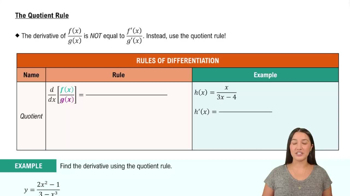
The Quotient Rule

Function Composition

Function composition involves combining two functions to create a new function. In the context of the given function ƒ(x) = (1/x) - x², it is important to recognize how the components interact. Understanding how to manipulate and simplify functions is essential for effectively working with the difference quotient and finding limits.
Recommended video:
3:48
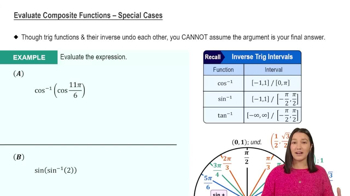
Evaluate Composite Functions - Special Cases

Limits

Limits are a core concept in calculus that describe the behavior of a function as its input approaches a certain value. They are essential for evaluating the difference quotient, especially when determining the derivative. In this case, simplifying the difference quotient may involve taking the limit as x approaches a, which provides insight into the function's behavior at that point.
Recommended video:
05:50
One-Sided Limits