

Ch. 4 - Applications of the Derivative
Briggs - Calculus: Early Transcendentals 3rd Edition
Briggs3rd EditionCalculus: Early TranscendentalsISBN: 9780136847243Not the one you use?Change textbook
Chapter 4, Problem 4.3.107f

Interpreting the derivative The graph of f' on the interval [-3,2] is shown in the figure. <IMAGE>


f. Sketch one possible graph of f.

Verified step by step guidance
1
Understand that the graph of f' represents the derivative of the function f, which indicates the slope of the tangent line to the graph of f at any given point.
Identify key features of the graph of f' such as where it is positive, negative, or zero. These features will help determine where the graph of f is increasing, decreasing, or has horizontal tangents.
Note the intervals where f' is positive, which means f is increasing in those intervals. Similarly, note where f' is negative, indicating that f is decreasing.
Look for points where f' is zero, as these correspond to critical points on the graph of f, where the slope of f is zero, possibly indicating local maxima, minima, or points of inflection.
Sketch the graph of f by integrating the behavior of f' over the interval [-3, 2], ensuring that the graph of f reflects the changes in slope indicated by f'.

Verified video answer for a similar problem:

This video solution was recommended by our tutors as helpful for the problem above.
Video duration:
4m
Was this helpful?

Key Concepts

Here are the essential concepts you must grasp in order to answer the question correctly.

Derivative Interpretation

The derivative of a function, denoted as f', represents the rate of change of the function f at any given point. It provides information about the slope of the tangent line to the graph of f. Understanding how to interpret the values of f'—whether they are positive, negative, or zero—helps in determining where the function is increasing, decreasing, or has critical points.
Recommended video:
05:44
Derivatives

Graph Behavior from Derivative

The graph of the derivative f' reveals important characteristics of the original function f. For instance, where f' is positive, f is increasing; where f' is negative, f is decreasing. Additionally, points where f' crosses the x-axis indicate potential local maxima or minima in f, as these are points where the slope changes from positive to negative or vice versa.
Recommended video:
06:15
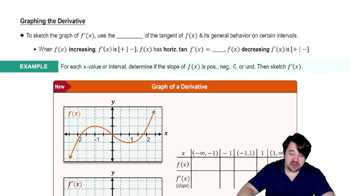
Graphing The Derivative

Sketching Functions from Derivatives

To sketch a possible graph of f based on the graph of f', one must translate the behavior indicated by f' into the shape of f. This involves identifying intervals of increase and decrease, as well as points of inflection and local extrema. By starting from a point on the graph and applying the information from f', one can create a continuous and smooth curve that reflects the changes in slope indicated by the derivative.
Recommended video:
11:41
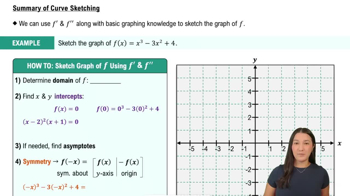
Summary of Curve Sketching
Related Practice
Textbook Question

107–110. {Use of Tech} Motion with gravity Consider the following descriptions of the vertical motion of an object subject only to the acceleration due to gravity. Begin with the acceleration equation a(t) = v' (t) = -g , where g = 9.8 m/s² .

d. Find the time when the object strikes the ground.

A payload is released at an elevation of 400 m from a hot-air balloon that is rising at a rate of 10 m/s.

56
views
Textbook Question

Rectangles in triangles Find the dimensions and area of the rectangle of maximum area that can be inscribed in the following figures.

d. An arbitrary triangle with a given area A (The result applies to any triangle, but first consider triangles for which all the angles are less than or equal to 90° .)

373
views
Textbook Question

Use the graphs of ƒ' and ƒ" to complete the following steps. <IMAGE>

Plot a possible graph of f.

238
views
Textbook Question

if ƒ(x) = 1 / (3x⁴ + 5) , it can be shown that ƒ'(x) = 12x³ / (3x⁴ + 5)² and ƒ"(x) = 180x² (x² + 1) (x + 1) (x - 1) / (3x⁴ + 5)³ . Use these functions to complete the following steps.


g. Use your work in parts (a) through (f) to sketch a graph of ƒ .

186
views
Textbook Question

{Use of Tech} A damped oscillator The displacement of an object as it bounces vertically up and down on a spring is given by y(t) = 2.5e⁻ᵗ cos 2t, where the initial displacement is y(0) = 2.5 and y = 0 corresponds to the rest position (see figure). <IMAGE>


d. Find the time and the displacement when the object reaches its high point for the second time.

210
views
Textbook Question

Let ƒ(x) = (x - 3) (x + 3)²


g. Use your work in parts (a) through (f) to sketch a graph of ƒ.

253
views