
Ch. 10 - Sequences and Infinite Series
Briggs - Calculus: Early Transcendentals 3rd Edition
Briggs3rd EditionCalculus: Early TranscendentalsISBN: 9780136847243Not the one you use?Change textbook
Chapter 10, Problem 10.R.29

27–37. Evaluating series Evaluate the following infinite series or state that the series diverges.
∑ (from k = 0 to ∞)((1/3)ᵏ + (4/3)ᵏ)

Verified step by step guidance
1
Identify the given series as the sum of two separate infinite series: \( \sum_{k=0}^\infty \left( \left(\frac{1}{3}\right)^k + \left(\frac{4}{3}\right)^k \right) = \sum_{k=0}^\infty \left(\frac{1}{3}\right)^k + \sum_{k=0}^\infty \left(\frac{4}{3}\right)^k \).
Recognize that each series is a geometric series of the form \( \sum_{k=0}^\infty r^k \), where \( r \) is the common ratio.
Recall the convergence criterion for a geometric series: it converges if and only if \( |r| < 1 \). If it converges, the sum is given by \( \frac{1}{1-r} \).
Check the common ratios: for the first series, \( r = \frac{1}{3} \), which satisfies \( |r| < 1 \), so it converges; for the second series, \( r = \frac{4}{3} \), which does not satisfy \( |r| < 1 \), so it diverges.
Conclude that since the second series diverges, the entire original series diverges and does not have a finite sum.

Verified video answer for a similar problem:

This video solution was recommended by our tutors as helpful for the problem above.
Video duration:
2m
Was this helpful?

Key Concepts

Here are the essential concepts you must grasp in order to answer the question correctly.

Infinite Geometric Series

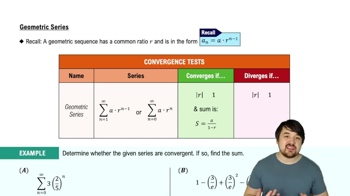
An infinite geometric series is a sum of terms where each term is obtained by multiplying the previous term by a constant ratio. It converges if the absolute value of the ratio is less than 1, and its sum can be found using the formula S = a / (1 - r), where a is the first term and r is the common ratio.
Recommended video:
06:00
Geometric Series

Convergence and Divergence of Series

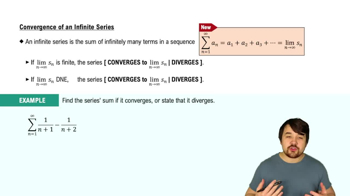
A series converges if the sum of its terms approaches a finite limit as the number of terms increases indefinitely. If the terms do not approach zero or the sum grows without bound, the series diverges. Determining convergence is essential before evaluating the sum.
Recommended video:
06:52
Convergence of an Infinite Series

Sum of a Series with Multiple Terms

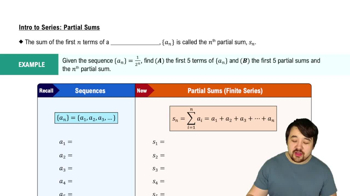
When a series is composed of sums of multiple sequences, the sum of the series is the sum of the individual series, provided each converges. This allows breaking down complex series into simpler parts that can be evaluated separately and then combined.
Recommended video:
06:45
Intro to Series: Partial Sums
Related Practice
Textbook Question

{Use of Tech} A savings plan

James begins a savings plan in which he deposits \(100 at the beginning of each month into an account that earns 9% interest annually, or equivalently, 0.75% per month.

To be clear, on the first day of each month, the bank adds 0.75% of the current balance as interest, and then James deposits \)100.


Let Bₙ be the balance in the account after the nᵗʰ payment, where B₀ = \$0.


a.Write the first five terms of the sequence {Bₙ}.

57
views
Textbook Question

Explain why or why not

Determine whether the following statements are true and give an explanation or counterexample.

a.If limₙ→∞aₙ = 1 and limₙ→∞bₙ = 3, then limₙ→∞(bₙ / aₙ) = 3.

48
views
Textbook Question

27–37. Evaluating series Evaluate the following infinite series or state that the series diverges.

∑ (from k = 0 to ∞)(tan⁻¹(k + 2) − tan⁻¹k)

81
views
Textbook Question

41–44. {Use of Tech} Remainders and estimates Consider the following convergent series.


a. Find an upper bound for the remainder in terms of n.


41. ∑ (k = 1 to ∞) 1 / k⁶

105
views
Textbook Question

89–90. {Use of Tech} Lower and upper bounds of a series

For each convergent series and given value of n, complete the following.


c. Find lower and upper bounds (Lₙ and Uₙ respectively) for the exact value of the series.


89.∑ (from k = 1 to ∞)1 / k⁵ ;n = 5

104
views
Textbook Question

42–76. Convergence or divergence Use a convergence test of your choice to determine whether the following series converge.

∑ (from k = 3 to ∞)ln(k) / k³ᐟ²

81
views