
Ch. 9 - Differential Equations
Briggs - Calculus: Early Transcendentals 3rd Edition
Briggs3rd EditionCalculus: Early TranscendentalsISBN: 9780136847243Not the one you use?Change textbook
Chapter 9, Problem 9.R.33b

A second-order equation Consider the equation


t² y′′(t) + 2ty′(t) − 12y(t) = 0


b. Assuming the general solution of the equation is


y(t) = C₁ tᵖ¹ + C₂ tᵖ²,


find the solution that satisfies the conditions


y(1) = 0, y′(1) = 7

Verified step by step guidance
1
Rewrite the given differential equation: \(t^{2} y''(t) + 2t y'(t) - 12 y(t) = 0\). This is a Cauchy-Euler (or equidimensional) equation, which suggests trying a solution of the form \(y(t) = t^{p}\).
Substitute \(y(t) = t^{p}\) into the differential equation. Compute the derivatives: \(y'(t) = p t^{p-1}\) and \(y''(t) = p (p-1) t^{p-2}\). Substitute these into the equation to get an algebraic equation in terms of \(p\).
After substitution, the equation becomes \(t^{2} imes p (p-1) t^{p-2} + 2t imes p t^{p-1} - 12 t^{p} = 0\). Simplify powers of \(t\) to get \(p (p-1) t^{p} + 2 p t^{p} - 12 t^{p} = 0\), which simplifies to \((p^{2} + p - 12) t^{p} = 0\).
Since \(t^{p} eq 0\) for \(t > 0\), set the characteristic equation \(p^{2} + p - 12 = 0\). Solve this quadratic equation to find the roots \(p_1\) and \(p_2\).
Write the general solution as \(y(t) = C_1 t^{p_1} + C_2 t^{p_2}\). Use the initial conditions \(y(1) = 0\) and \(y'(1) = 7\) to form a system of equations in \(C_1\) and \(C_2\). Compute \(y'(t)\), substitute \(t=1\), and solve the system to find \(C_1\) and \(C_2\).

Verified video answer for a similar problem:

This video solution was recommended by our tutors as helpful for the problem above.
Video duration:
5m
Was this helpful?

Key Concepts

Here are the essential concepts you must grasp in order to answer the question correctly.

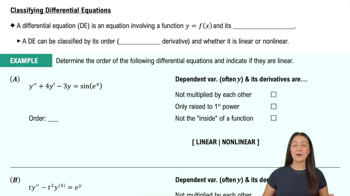
Second-Order Linear Differential Equations

These are differential equations involving the second derivative of a function. The given equation is linear and homogeneous, meaning it can be solved by finding characteristic solutions that satisfy the equation. Understanding the structure helps in applying appropriate solution methods.
Recommended video:
07:39
Classifying Differential Equations

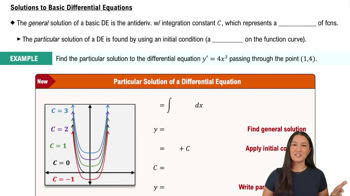
Characteristic Equation and Power Solutions

For equations of the form t²y'' + 2ty' - 12y = 0, solutions often take the form y = t^p. Substituting this form leads to a characteristic equation in terms of p, whose roots determine the general solution. This method transforms the differential equation into an algebraic problem.
Recommended video:
04:00
Solutions to Basic Differential Equations

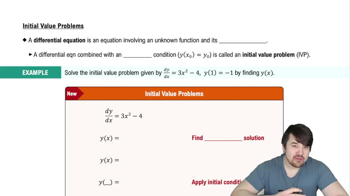
Initial Conditions and Solving for Constants

Initial conditions like y(1) = 0 and y'(1) = 7 allow us to find the specific constants C₁ and C₂ in the general solution. By substituting t = 1 into y(t) and y'(t), we create a system of equations to solve for these constants, yielding the particular solution.
Recommended video:
05:03
Initial Value Problems