Ch. 8 - Integration Techniques
Briggs - Calculus: Early Transcendentals 3rd Edition
Briggs3rd EditionCalculus: Early TranscendentalsISBN: 9780136847243Not the one you use?Change textbook
Chapter 8, Problem 8.5.76

76–83. Preliminary steps The following integrals require a preliminary step such as a change of variables before using the method of partial fractions. Evaluate these integrals.
76. ∫ [cosθ / (sin³θ - 4sinθ)] dθ

Verified step by step guidance
1
Identify a suitable substitution to simplify the integral. Notice that the denominator involves powers of \( \sin \theta \), so let \( u = \sin \theta \).
Compute the differential \( du \) in terms of \( d\theta \). Since \( u = \sin \theta \), then \( du = \cos \theta \, d\theta \).
Rewrite the integral in terms of \( u \) and \( du \). The numerator \( \cos \theta \, d\theta \) becomes \( du \), and the denominator \( \sin^3 \theta - 4 \sin \theta \) becomes \( u^3 - 4u \). So the integral becomes \( \int \frac{du}{u^3 - 4u} \).
Factor the denominator \( u^3 - 4u \) to prepare for partial fraction decomposition. Factor out \( u \) to get \( u(u^2 - 4) \), and recognize \( u^2 - 4 \) as a difference of squares: \( (u - 2)(u + 2) \).
Set up the partial fraction decomposition for \( \frac{1}{u(u - 2)(u + 2)} \) and solve for the constants. Then integrate each term separately with respect to \( u \).

Verified video answer for a similar problem:

This video solution was recommended by our tutors as helpful for the problem above.
Video duration:
8m
Was this helpful?

Key Concepts

Here are the essential concepts you must grasp in order to answer the question correctly.

Change of Variables (Substitution)

This technique involves replacing a complicated expression with a simpler variable to make integration easier. For example, substituting u = sinθ can transform the integral into a rational function in terms of u, simplifying the integrand before further methods are applied.
Recommended video:
04:27
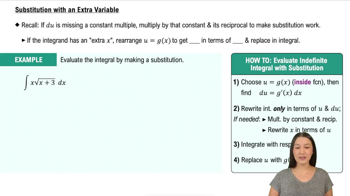
Substitution With an Extra Variable

Partial Fraction Decomposition

Partial fractions break down a complex rational expression into simpler fractions that are easier to integrate. After substitution, the integrand often becomes a rational function where this method helps separate terms for straightforward integration.
Recommended video:
10:07
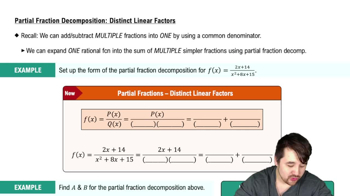
Partial Fraction Decomposition: Distinct Linear Factors

Trigonometric Identities and Simplification

Using identities like sin²θ + cos²θ = 1 or factoring expressions involving sine and cosine can simplify the integrand. Recognizing these patterns is essential before substitution or partial fractions to reduce the integral to a manageable form.
Recommended video:
7:17
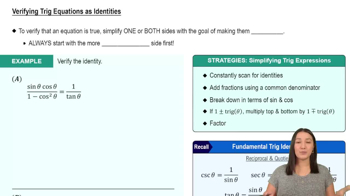
Verifying Trig Equations as Identities
Related Practice
Textbook Question

108. Draining a tank Water is drained from a 3000-gal tank at a rate that starts at 100 gal/hr and decreases continuously by 5%/hr. If the drain is left open indefinitely, how much water drains from the tank? Can a full tank be emptied at this rate? 

38
views
Textbook Question

Visual proof Let F(x)=∫₀ˣ √(a²−t²) dt. The figure shows that F(x)= area of sector OAB+ area of triangle OBC.

a. Use the figure to prove that

F(x) = (a² sin ⁻¹(x/a))/2 + x√(a²−x²)/2

b. Conclude that ∫ √(a²−x²) dx = (a² sin ⁻¹(x/a))/2 + x√(a²−x²)/2 + C.

47
views
Textbook Question

102–106. Laplace transforms A powerful tool in solving problems in engineering and physics is the Laplace transform. Given a function f(t), the Laplace transform is a new function F(s) defined by F(s) = ∫[0 to ∞] e^(-st) f(t) dt, where we assume s is a positive real number. For example, to find the Laplace transform of f(t) = e^(-t), the following improper integral is evaluated using integration by parts:

F(s) = ∫[0 to ∞] e^(-st) e^(-t) dt = ∫[0 to ∞] e^(-(s+1)t) dt = 1/(s+1).

Verify the following Laplace transforms, where a is a real number.

106. f(t) = cos(at) → F(s) = s/(s² + a²)

47
views
Textbook Question

64. (Use of Tech) Normal distribution of movie lengths

A study revealed that the lengths of U.S. movies are normally distributed with a mean of 110 minutes and a standard deviation of 22 minutes. This means that the fraction of movies with lengths between a and b minutes (with a < b) is given by the integral:

(1/(22√(2π))) ∫[a to b] e^(-((x-110)/22)²/2) dx.

What percentage of U.S. movies are between 1 hr and 1.5 hr long (60-90 min)?

73
views
Textbook Question

9–40. Integration by parts Evaluate the following integrals using integration by parts.

40. ∫ e^√x dx

48
views
Textbook Question

7–84. Evaluate the following integrals.

25. ∫ [1 / (x√(1 - x²))] dx

89
views