Ch. 2 - Limits and Continuity
Hass - Thomas' Calculus 15th Edition
Hass15th EditionThomas' CalculusISBN: 9780137616077Not the one you use?Change textbook
Chapter 2, Problem 2.7a

Limits and Continuity
On what intervals are the following functions continuous?


a. ƒ(x) = x¹/³

Verified step by step guidance
1
Understand the concept of continuity: A function is continuous at a point if the limit of the function as it approaches the point from both sides is equal to the function's value at that point.
Identify the type of function: The function ƒ(x) = x^(1/3) is a root function, specifically a cube root function.
Consider the domain of the function: Cube root functions are defined for all real numbers, meaning there are no restrictions on x for ƒ(x) = x^(1/3).
Analyze the behavior of the function: Since cube root functions do not have any discontinuities like jumps, holes, or vertical asymptotes, they are continuous everywhere in their domain.
Conclude the intervals of continuity: Based on the analysis, ƒ(x) = x^(1/3) is continuous on the interval (-∞, ∞), which includes all real numbers.

Verified video answer for a similar problem:

This video solution was recommended by our tutors as helpful for the problem above.
Video duration:
2m
Was this helpful?

Key Concepts

Here are the essential concepts you must grasp in order to answer the question correctly.

Continuity of Functions

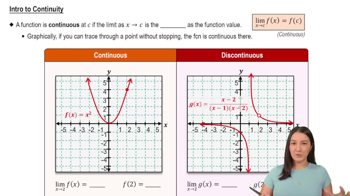
A function is continuous at a point if the limit of the function as it approaches that point equals the function's value at that point. For a function to be continuous over an interval, it must be continuous at every point within that interval. This concept is crucial for determining where a function does not have breaks, jumps, or asymptotes.
Recommended video:
05:34
Intro to Continuity

Limits

Limits describe the behavior of a function as it approaches a certain point from either side. Understanding limits is essential for analyzing continuity, as a function can only be continuous if the limit exists and matches the function's value at that point. This concept helps in identifying points of discontinuity in a function.
Recommended video:
05:50
One-Sided Limits

Types of Discontinuities

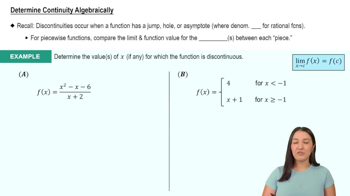
Discontinuities can be classified into three main types: removable, jump, and infinite. A removable discontinuity occurs when a function is not defined at a point but can be made continuous by redefining it. Jump discontinuities happen when the left-hand and right-hand limits exist but are not equal, while infinite discontinuities occur when a function approaches infinity at a point. Recognizing these types is vital for analyzing the continuity of functions.
Recommended video:
05:25
Determine Continuity Algebraically