
Observers at positions A and B 2 km apart simultaneously measure the angle of elevation of a weather balloon to be 40° and 70°, respectively. If the balloon is directly above a point on the line segment between A and B, find the height of the balloon.
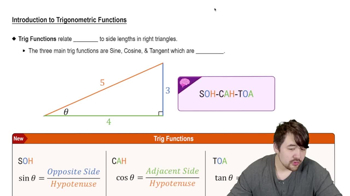
In Exercises 65–68, ABC is a right triangle with the right angle at C. The sides opposite angles A, B, and C are a, b, and c, respectively.
a. Find a and b if c = 2, B = π/3.
b. Find a and c if b = 2, B = π/3.
Verified step by step guidance
Verified video answer for a similar problem:
Key Concepts
Pythagorean Theorem
Trigonometric Ratios
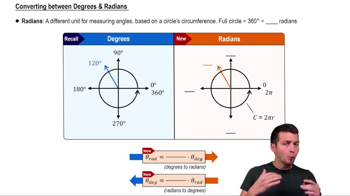
Angle Measures in Radians
Two wires stretch from the top T of a vertical pole to points B and C on the ground, where C is 10 m closer to the base of the pole than is B. If wire BT makes an angle of 35° with the horizontal and wire CT makes an angle of 50° with the horizontal, how high is the pole?
A triangle has side c = 2 and angles A = π/4 and B = π/3. Find the length a of the side opposite A.
The law of sines The law of sines says that if a, b, and c are the sides opposite the angles A, B, and C in a triangle, then
(sin A) / a = (sin B) / b = (sin C) / c
Use the accompanying figures and the identity sin (π − θ) = sin θ, if required, to derive the law.
In Exercises 65–68, ABC is a right triangle with the right angle at C. The sides opposite angles A, B, and C are a, b, and c, respectively.
a. Express sin A in terms of a and c.
b. Express sin A in terms of b and c.
In Exercises 59–62, sketch the graph of the given function. What is the period of the function?
𝔂 = cos πx/2
