What is the derivative of y = e^kx?
Ch. 3 - Derivatives
Briggs3rd EditionCalculus: Early TranscendentalsISBN: 9780136847243Not the one you use?Change textbook
Chapter 3, Problem 12b
The sides of a square decrease in length at a rate of 1 m/s.
b. At what rate are the lengths of the diagonals of the square changing?
Verified step by step guidance1
Start by understanding the relationship between the side length of the square and its diagonal. If the side length of the square is 's', then the diagonal 'd' can be found using the Pythagorean theorem: \( d = \sqrt{2} \cdot s \).
Differentiate the equation for the diagonal with respect to time 't' to find the rate of change of the diagonal. This gives us \( \frac{dd}{dt} = \sqrt{2} \cdot \frac{ds}{dt} \).
We know from the problem that the side length 's' is decreasing at a rate of 1 m/s, so \( \frac{ds}{dt} = -1 \) m/s.
Substitute \( \frac{ds}{dt} = -1 \) m/s into the differentiated equation: \( \frac{dd}{dt} = \sqrt{2} \cdot (-1) \).
Simplify the expression to find the rate at which the diagonal is changing. This will give you the rate of change of the diagonal in meters per second.

Verified video answer for a similar problem:
This video solution was recommended by our tutors as helpful for the problem above.
Video duration:
2mWas this helpful?
Key Concepts
Here are the essential concepts you must grasp in order to answer the question correctly.
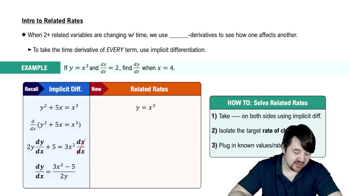
Related Rates
Related rates involve finding the rate at which one quantity changes in relation to another. In this problem, we need to determine how the rate of change of the square's side length affects the rate of change of its diagonal length. This concept is essential for solving problems where multiple variables are interdependent.
Recommended video:
Intro To Related Rates
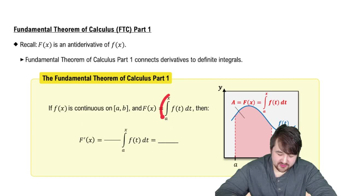
Pythagorean Theorem
The Pythagorean theorem states that in a right triangle, the square of the length of the hypotenuse is equal to the sum of the squares of the lengths of the other two sides. For a square, the diagonal can be calculated using this theorem, where the diagonal is the hypotenuse and the sides are the legs of the triangle formed. This relationship is crucial for finding the diagonal's length as the sides change.
Recommended video:
Fundamental Theorem of Calculus Part 1
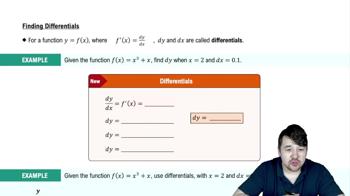
Differentiation
Differentiation is a fundamental concept in calculus that involves finding the derivative of a function, which represents the rate of change of that function with respect to a variable. In this context, we will differentiate the formula for the diagonal length of the square with respect to time to find how fast the diagonal is changing as the side lengths decrease.
Recommended video:
Finding Differentials
Related Practice
Textbook Question
584
views
Textbook Question
Shrinking square The sides of a square decrease in length at a rate of 1 m/s.
a. At what rate is the area of the square changing when the sides are 5 m long?
291
views
Textbook Question
The legs of an isosceles right triangle increase in length at a rate of 2 m/s.
c. At what rate is the length of the hypotenuse changing?
320
views
Textbook Question
Let F(x) = f(x) + g(x),G(x) = f(x) - g(x), and H(x) = 3f(x) + 2g(x), where the graphs of f and g are shown in the figure. Find each of the following.
<IMAGE>
H'(2)
442
views
Textbook Question
7–14. Find the derivative the following ways:
a. Using the Product Rule (Exercises 7–10) or the Quotient Rule (Exercises 11–14). Simplify your result.
y = x² - a² / x-a, where a is a constant
359
views
Textbook Question
Use the table to find the following derivatives.
<IMAGE>
d/dx (f(x) + g(x)) ∣x=1
368
views