
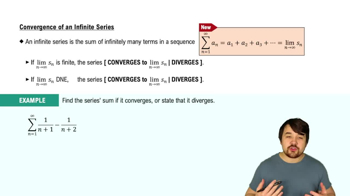
71. Evaluating an infinite series two ways
Evaluate the series
∑ (k = 1 to ∞) (4 / 3ᵏ – 4 / 3ᵏ⁺¹) two ways.
a. Use a telescoping series argument.
Verified step by step guidance
71. Evaluating an infinite series two ways
Evaluate the series
∑ (k = 1 to ∞) (4 / 3ᵏ – 4 / 3ᵏ⁺¹) two ways.
a. Use a telescoping series argument.
39–40. {Use of Tech} Lower and upper bounds of a series
For each convergent series and given value of n, use Theorem 10.13 to complete the following.
a. Use Sₙ to estimate the sum of the series.
39. ∑ (k = 1 to ∞) 1 / k⁷ ; n = 2
Explain why or why not
Determine whether the following statements are true and give an explanation or counterexample.
a. If the Limit Comparison Test can be applied successfully to a given series with a certain comparison series, the Comparison Test also works with the same comparison series.
57–60. Heights of bouncing balls A ball is thrown upward to a height of hₒ meters. After each bounce, the ball rebounds to a fraction r of its previous height. Let hₙ be the height after the nth bounce. Consider the following values of hₒ and r.
a. Find the first four terms of the sequence of heights {hₙ}.
h₀ = 20,r = 0.5
Explain why or why not
Determine whether the following statements are true and give an explanation or counterexample.
a.The sequence of partial sums for the series1 + 2 + 3 + ⋯ is {1, 3, 6, 10, …}.
72–75. {Use of Tech} Practical sequences
Consider the following situations that generate a sequence
a.Write out the first five terms of the sequence.
Radioactive decay
A material transmutes 50% of its mass to another element every 10 years due to radioactive decay. Let Mₙ be the mass of the radioactive material at the end of the nᵗʰ decade, where the initial mass of the material is M₀ = 20g.