
Ch. 11 - Power Series
Briggs - Calculus: Early Transcendentals 3rd Edition
Briggs3rd EditionCalculus: Early TranscendentalsISBN: 9780136847243Not the one you use?Change textbook
Chapter 11, Problem 11.1.45

Remainders Find the remainder Rₙ for the nth−order Taylor polynomial centered at a for the given functions. Express the result for a general value of n.


f(x) = sin x, a = π/2

Verified step by step guidance
1
Recall that the remainder term \( R_n(x) \) for the nth-order Taylor polynomial of a function \( f(x) \) centered at \( a \) is given by the Lagrange form of the remainder: \[ R_n(x) = \frac{f^{(n+1)}(c)}{(n+1)!} (x - a)^{n+1} \] where \( c \) is some value between \( a \) and \( x \).
Identify the function and the center: here, \( f(x) = \sin x \) and \( a = \frac{\pi}{2} \). We need to find the \( (n+1) \)-th derivative of \( \sin x \).
Determine the pattern of derivatives of \( \sin x \): \[ f(x) = \sin x \] \[ f'(x) = \cos x \] \[ f''(x) = -\sin x \] \[ f^{(3)}(x) = -\cos x \] \[ f^{(4)}(x) = \sin x \] Notice the derivatives repeat every 4 steps. Use this cyclic pattern to express \( f^{(n+1)}(x) \) in terms of \( \sin x \) or \( \cos x \) with appropriate signs.
Evaluate \( f^{(n+1)}(c) \) at some \( c \) between \( a = \frac{\pi}{2} \) and \( x \). Since \( c \) is unknown but lies in this interval, keep \( f^{(n+1)}(c) \) in the expression to represent the remainder.
Write the remainder term explicitly as: \[ R_n(x) = \frac{f^{(n+1)}(c)}{(n+1)!} (x - \frac{\pi}{2})^{n+1} \] where \( f^{(n+1)}(c) \) follows the derivative pattern of \( \sin x \) and \( c \) is between \( \frac{\pi}{2} \) and \( x \). This expression represents the remainder for the nth-order Taylor polynomial centered at \( \frac{\pi}{2} \).

Verified video answer for a similar problem:

This video solution was recommended by our tutors as helpful for the problem above.
Video duration:
5m
Was this helpful?

Key Concepts

Here are the essential concepts you must grasp in order to answer the question correctly.

Taylor Polynomial and Taylor Series

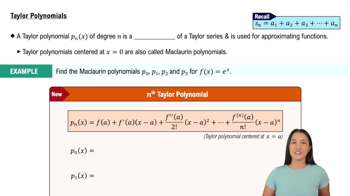
A Taylor polynomial approximates a function near a point a using derivatives of the function at a. The nth-order Taylor polynomial includes terms up to the nth derivative, providing a polynomial approximation of the function around a. Understanding this helps in constructing the polynomial for sin x centered at π/2.
Recommended video:
07:00
Taylor Polynomials

Remainder Term (Lagrange Form)

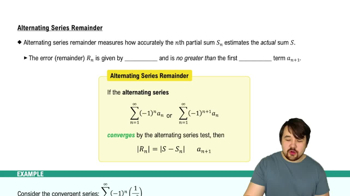
The remainder term Rₙ measures the error between the actual function and its nth-order Taylor polynomial. The Lagrange form expresses Rₙ as a function involving the (n+1)th derivative evaluated at some point between a and x, helping to bound or express the error explicitly.
Recommended video:
06:32
Alternating Series Remainder

Derivatives of sin x and their Patterns

The derivatives of sin x cycle every four steps: sin x, cos x, -sin x, -cos x, then repeat. Recognizing this pattern is essential to find the (n+1)th derivative needed for the remainder term when centered at π/2, simplifying the expression of Rₙ.
Recommended video:
04:56
Derivative of the Natural Exponential Function (e^x)
Related Practice
Textbook Question

{Use of Tech} Newton's derivation of the sine and arcsine series Newton discovered the binomial series and then used it ingeniously to obtain many more results. Here is a case in point.

a. Referring to the figure, show that x = sin s or s = sin ⁻¹ x.

b. The area of a circular sector of radius r subtended by an angle θ is 1/2r²θ. Show that the area of the circular sector APE is s/2, which implies that

s = 2 ∫₀ˣ √(1 − t²) dt − x √(1 −x²)

c. Use the binomial series for f(x) = √(1 − x²) to obtain the first few terms of the Taylor series for s=sin ⁻¹ x.

d. Newton next inverted the series in part (c) to obtain the Taylor series for x=sin s. He did this by assuming sin s = ∑ aₖ sᵏ and solving x = sin(sin ⁻¹ x) for the coefficients aₖ. Find the first few terms of the Taylor series for sin s using this idea (a computer algebra system might be helpful as well).

124
views
Textbook Question

Derivative trick Here is an alternative way to evaluate higher derivatives of a function f that may save time. Suppose you can find the Taylor series for f centered at the point a without evaluating derivatives (for example, from a known series). Then f⁽ᵏ⁾(a)=k! multiplied by the coefficient of (x−a)ᵏ. Use this idea to evaluate f⁽³⁾(0) and f⁽⁴⁾(0) for the following functions. Use known series and do not evaluate derivatives.


f(x) = ∫₀ˣ sin t² dt

74
views
Textbook Question

Radius and interval of convergence Determine the radius and interval of convergence of the following power series.

∑ₖ₌₀∞ k(x−1)ᵏ

71
views
Textbook Question

Power series for derivatives


a. Differentiate the Taylor series centered at 0 for the following functions.

b. Identify the function represented by the differentiated series.

c. Give the interval of convergence of the power series for the derivative.


f(x) = eˣ

47
views
Textbook Question

Does the accuracy of an approximation given by a Taylor polynomial generally increase or decrease with the order of the approximation? Explain.

84
views
Textbook Question

Limits Evaluate the following limits using Taylor series.

lim ₓ→₄ (x² 16)/(ln (x 3)}

75
views