Ch. 2 - Limits
Briggs - Calculus: Early Transcendentals 3rd Edition
Briggs3rd EditionCalculus: Early TranscendentalsISBN: 9780136847243Not the one you use?Change textbook
Chapter 2, Problem 2.14

Describe the end behavior of g(x) = e-2x.

Verified step by step guidance
1
Consider the function \(g(x) = e^{-2x}\).
Recall that the exponential function \(e^x\) has a horizontal asymptote at \(y = 0\) as \(x \to -\infty\).
For \(g(x) = e^{-2x}\), as \(x \to \infty\), the exponent \(-2x\) becomes very large and negative, making \(e^{-2x}\) approach 0.
As \(x \to -\infty\), the exponent \(-2x\) becomes very large and positive, making \(e^{-2x}\) grow without bound.
Thus, the end behavior of \(g(x)\) is: as \(x \to \infty\), \(g(x) \to 0\); as \(x \to -\infty\), \(g(x) \to \infty\).

Verified video answer for a similar problem:

This video solution was recommended by our tutors as helpful for the problem above.
Video duration:
3m
Was this helpful?

Key Concepts

Here are the essential concepts you must grasp in order to answer the question correctly.

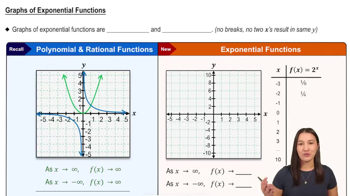
End Behavior of Functions

End behavior refers to the behavior of a function as the input values approach positive or negative infinity. It helps in understanding how the function behaves at the extremes of its domain, which is crucial for sketching graphs and analyzing limits.
Recommended video:
5:46
Graphs of Exponential Functions

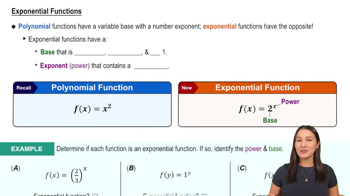
Exponential Functions

Exponential functions are mathematical expressions of the form f(x) = a * b^x, where 'a' is a constant, 'b' is a positive base, and 'x' is the exponent. The function g(x) = e^(-2x) is an example, where 'e' is the base of natural logarithms, and the negative exponent indicates a decay as 'x' increases.
Recommended video:
6:13
Exponential Functions

Limits at Infinity

Limits at infinity are used to determine the value that a function approaches as the input grows larger or smaller without bound. For g(x) = e^(-2x), analyzing the limit as x approaches infinity reveals that the function approaches zero, indicating that it decays towards the x-axis.
Recommended video:
05:50
One-Sided Limits