
Textbook Question
45–60. Areas of regions Find the area of the following regions.
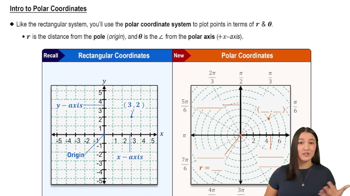
The region outside the circle r = 1/2 and inside the circle r = cos θ
76
views

 Verified step by step guidance
 05:32
05:32
 7:17
7:17 04:47
04:4745–60. Areas of regions Find the area of the following regions.
The region outside the circle r = 1/2 and inside the circle r = cos θ
29–32. Intersection points Use algebraic methods to find as many intersection points of the following curves as possible. Use graphical methods to identify the remaining intersection points.
r = 1 and r = 2 sin 2θ
63–74. Arc length of polar curves Find the length of the following polar curves.
The spiral r = θ², for 0 ≤ θ ≤ 2π
39–50. Equations of ellipses and hyperbolas Find an equation of the following ellipses and hyperbolas, assuming the center is at the origin.
A hyperbola with vertices (±2, 0) and asymptotes y = ±3x/2
23–24. Radar Airplanes are equipped with transponders that allow air traffic controllers to see their locations on radar screens. Radar gives the distance of the plane from the radar station (located at the origin) and the angular position of the plane, typically measured in degrees clockwise from north.
A plane is 50 miles from a radar station at an angle of 10 dgeree clockwise from north. Find polar coordinates for the location of the plane.
9–13. Graph the points with the following polar coordinates. Give two alternative representations of the points in polar coordinates.
(-1, -π/3)