Ch. 5 - Integration
Briggs - Calculus: Early Transcendentals 3rd Edition
Briggs3rd EditionCalculus: Early TranscendentalsISBN: 9780136847243Not the one you use?Change textbook
Chapter 5, Problem 5.R.105d

Area functions and the Fundamental Theorem Consider the function
ƒ(t) = { t      if  ―2 ≤ t < 0
t²/2    if    0 ≤ t ≤ 2
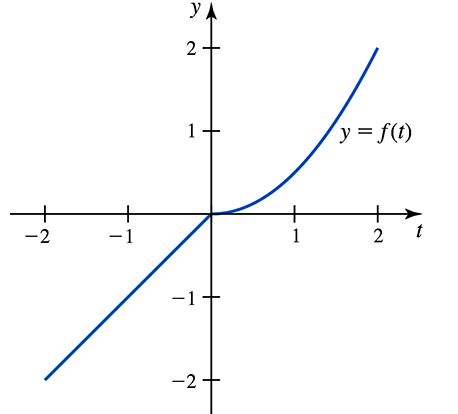
and its graph shown below. Let F(𝓍) = ∫₋₁ˣ ƒ(t) dt and G(𝓍) = ∫₋₂ˣ ƒ(t) dt.

(d) Evaluate F ' (―1) and F ' (1). Interpret these values.

Verified step by step guidance
1
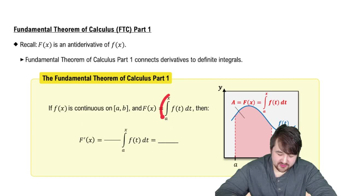
Step 1: Recall the Fundamental Theorem of Calculus, which states that if F(x) = ∫ₐˣ ƒ(t) dt, then F'(x) = ƒ(x). This means the derivative of the area function F(x) is equal to the value of the function ƒ(x) at x.
Step 2: To evaluate F'(−1), observe that F'(x) = ƒ(x). From the graph and the piecewise definition of ƒ(t), for −2 ≤ t < 0, ƒ(t) = t. Therefore, ƒ(−1) = −1.
Step 3: To evaluate F'(1), observe again that F'(x) = ƒ(x). From the graph and the piecewise definition of ƒ(t), for 0 ≤ t ≤ 2, ƒ(t) = t²/2. Therefore, ƒ(1) = (1²)/2 = 1/2.
Step 4: Interpret the values: F'(−1) = −1 indicates that at x = −1, the rate of change of the area function F(x) is equal to the value of ƒ(t) at t = −1, which is −1. Similarly, F'(1) = 1/2 indicates that at x = 1, the rate of change of the area function F(x) is equal to the value of ƒ(t) at t = 1, which is 1/2.
Step 5: The values of F'(−1) and F'(1) provide insight into how the function ƒ(t) contributes to the accumulation of area in F(x) at specific points. Negative values of ƒ(t) (e.g., at t = −1) reduce the accumulated area, while positive values (e.g., at t = 1) increase it.

Verified video answer for a similar problem:

This video solution was recommended by our tutors as helpful for the problem above.
Video duration:
3m
Was this helpful?

Key Concepts

Here are the essential concepts you must grasp in order to answer the question correctly.

Fundamental Theorem of Calculus

The Fundamental Theorem of Calculus links the concept of differentiation and integration, stating that if F is an antiderivative of f on an interval [a, b], then the integral of f from a to b is equal to F(b) - F(a). This theorem allows us to evaluate definite integrals and understand the relationship between a function and its area under the curve.
Recommended video:
06:11
Fundamental Theorem of Calculus Part 1

Derivative of an Integral Function

When evaluating the derivative of an integral function, such as F(x) = ∫₋₁ˣ f(t) dt, we apply the Fundamental Theorem of Calculus. The derivative F'(x) gives us the value of the integrand f evaluated at the upper limit of integration, which provides insight into the rate of change of the area under the curve as x varies.
Recommended video:
05:11
Integrals of General Exponential Functions

Piecewise Functions

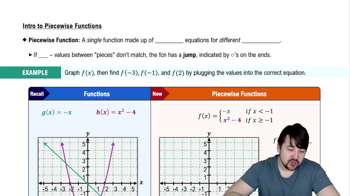
A piecewise function is defined by different expressions based on the input value. In this case, the function f(t) has two distinct expressions depending on whether t is less than 0 or between 0 and 2. Understanding how to evaluate and differentiate piecewise functions is crucial for correctly applying calculus concepts to such functions.
Recommended video:
05:36
Piecewise Functions
Related Practice
Textbook Question

Change of variables Use the change of variables u³ = 𝓍² ― 1 to evaluate the integral ∫₁³ 𝓍∛(𝓍²―1) d𝓍 .

165
views

Textbook Question

Evaluating integrals Evaluate the following integrals.


∫π/₁₂^π/⁹ (csc 3𝓍 cot 3𝓍 + sec 3𝓍 tan 3𝓍) d𝓍

42
views
Textbook Question

Displacement from velocity A particle moves along a line with a velocity given by v(t) = 5 sin πt, starting with an initial position s(0) = 0 . Find the displacement of the particle between t = 0 and t = 2 , which is given by s(t) = ∫₀² v(t) dt . Find the distance traveled by the particle during this interval, which is ∫₀² |v(t)| dt .

194
views
Textbook Question

Evaluating integrals Evaluate the following integrals.                                                                                                                                         


 ∫ y² (3y³ + 1)⁴ dy

70
views
Textbook Question

Estimate ∫₁⁴ √(4𝓍 + 1) d𝓍 by evaluating the left, right, and midpoint Riemann sums using a regular partition with n = 6 subintervals.

65
views
Textbook Question

Velocity to displacement An object travels on the 𝓍-axis with a velocity given by v(t) = 2t + 5, for 0 ≤ t ≤ 4.


(c) True or false: The object would travel as far as in part (a) if it traveled at its average velocity (a constant), for 0 ≤ t ≤ 4. .

80
views