Ch. 10 - Sequences and Infinite Series
Briggs - Calculus: Early Transcendentals 3rd Edition
Briggs3rd EditionCalculus: Early TranscendentalsISBN: 9780136847243Not the one you use?Change textbook
Chapter 10, Problem 10.2.11

Compare the growth rates of {n¹⁰⁰} and {eⁿ⁄¹⁰⁰} as n → ∞.

Verified step by step guidance
1
Identify the two functions to compare: \(f(n) = n^{100}\) and \(g(n) = e^{\frac{n}{100}}\).
Recall that to compare growth rates as \(n \to \infty\), we often consider the limit of their ratio, such as \(\lim_{n \to \infty} \frac{f(n)}{g(n)}\) or \(\lim_{n \to \infty} \frac{g(n)}{f(n)}\).
Set up the limit \(L = \lim_{n \to \infty} \frac{n^{100}}{e^{\frac{n}{100}}}\) to analyze which function grows faster.
Apply L'Hôpital's Rule if the limit is an indeterminate form like \(\frac{\infty}{\infty}\) by differentiating numerator and denominator with respect to \(n\) repeatedly, or use properties of exponential and polynomial functions to reason about the limit.
Conclude the comparison based on the limit: if \(L = 0\), then \(g(n)\) grows faster; if \(L = \infty\), then \(f(n)\) grows faster; if \(L\) is a finite nonzero constant, they grow at comparable rates.

Verified video answer for a similar problem:

This video solution was recommended by our tutors as helpful for the problem above.
Video duration:
3m
Was this helpful?

Key Concepts

Here are the essential concepts you must grasp in order to answer the question correctly.

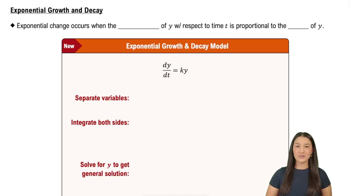
Exponential Growth

Exponential growth refers to functions where the variable appears in the exponent, such as e^(n/100). These functions increase much faster than polynomial functions as n becomes very large, often dominating growth rates in limits approaching infinity.
Recommended video:
09:29
Exponential Growth & Decay

Polynomial Growth

Polynomial growth involves functions where the variable is raised to a fixed power, like n^100. Although these functions grow quickly for large n, their growth rate is slower compared to exponential functions when n approaches infinity.
Recommended video:
07:00
Taylor Polynomials

Limit Comparison of Growth Rates

To compare growth rates as n → ∞, we analyze the limit of the ratio of the two functions. If the limit is zero, the numerator grows slower; if infinite, it grows faster. This method helps determine which function dominates in the long run.
Recommended video:
04:16
Intro To Related Rates