
Ch. 4 - Applications of the Derivative
Briggs - Calculus: Early Transcendentals 3rd Edition
Briggs3rd EditionCalculus: Early TranscendentalsISBN: 9780136847243Not the one you use?Change textbook
Chapter 4, Problem 52

First Derivative Test


a. Locate the critical points of f.
b. Use the First Derivative Test to locate the local maximum and minimum values.
c. Identify the absolute maximum and minimum values of the function on the given interval (when they exist).


f(x) = x²/(x² - 1) on [-4,4]

Verified step by step guidance
1
To find the critical points of the function \( f(x) = \frac{x^2}{x^2 - 1} \), first compute the derivative \( f'(x) \). Use the quotient rule: \( f'(x) = \frac{(x^2 - 1)(2x) - x^2(2x)}{(x^2 - 1)^2} \). Simplify the expression to find \( f'(x) \).
Set \( f'(x) = 0 \) to find the critical points. Solve the equation \( (x^2 - 1)(2x) - x^2(2x) = 0 \) to find the values of \( x \) where the derivative is zero. Also, consider where the derivative is undefined, which occurs when the denominator \( (x^2 - 1)^2 = 0 \).
Use the First Derivative Test to determine the nature of each critical point. Analyze the sign of \( f'(x) \) on intervals around each critical point to determine if the function is increasing or decreasing, which will help identify local maxima and minima.
To find the absolute maximum and minimum values on the interval \([-4, 4]\), evaluate \( f(x) \) at the critical points found within the interval and at the endpoints \( x = -4 \) and \( x = 4 \). Compare these values to determine the absolute extrema.
Consider the behavior of \( f(x) \) as \( x \) approaches the points where the function is undefined (i.e., \( x = \pm 1 \)) to ensure these do not affect the determination of absolute extrema on the closed interval.

Verified video answer for a similar problem:

This video solution was recommended by our tutors as helpful for the problem above.
Video duration:
7m
Was this helpful?

Key Concepts

Here are the essential concepts you must grasp in order to answer the question correctly.

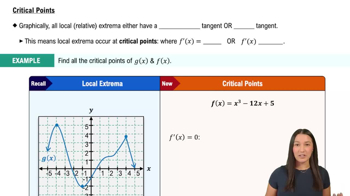
Critical Points

Critical points of a function occur where its derivative is zero or undefined. These points are essential for identifying local maxima and minima, as they represent potential locations where the function's behavior changes. To find critical points, one must first compute the derivative of the function and solve for values of x that satisfy the derivative equation.
Recommended video:
04:50
Critical Points

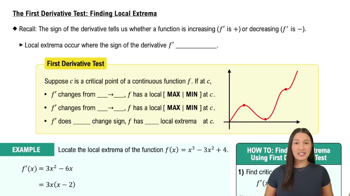
First Derivative Test

The First Derivative Test is a method used to determine whether a critical point is a local maximum, local minimum, or neither. By analyzing the sign of the derivative before and after the critical point, one can conclude that if the derivative changes from positive to negative, a local maximum exists; if it changes from negative to positive, a local minimum is present.
Recommended video:
07:09
The First Derivative Test: Finding Local Extrema

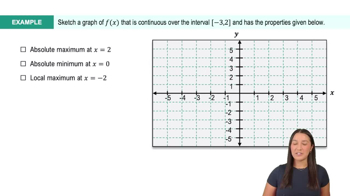
Absolute Maximum and Minimum

The absolute maximum and minimum values of a function on a closed interval are the highest and lowest values the function attains within that interval, including at the endpoints. To find these values, one must evaluate the function at the critical points and the endpoints of the interval, comparing these values to determine which is the largest and which is the smallest.
Recommended video:
03:22
Finding Extrema Graphically Example 4
Related Practice
Textbook Question

Travel costs A simple model for travel costs involves the cost of gasoline and the cost of a driver. Specifically, assume gasoline costs \(p/gallon and the vehicle gets g miles per gallon. Also assume the driver earns \)w/hour.


e. Should the optimal speed be increased or decreased (compared with part (d)) if L is increased from 400 mi to 500 mi? Explain.

248
views
Textbook Question

Mean Value Theorem The population of a culture of cells grows according to the function P(t) = 100t / t+1, where t ≥ 0 is measured in weeks.


b. At what point of the interval [0, 8] is the instantaneous rate of change equal to the average rate of change?

183
views
Textbook Question

First Derivative Test


a. Locate the critical points of f.

b. Use the First Derivative Test to locate the local maximum and minimum values.

c. Identify the absolute maximum and minimum values of the function on the given interval (when they exist).


f(x) = x - 2 tan⁻¹ x on [-√3,√3)

154
views
Textbook Question

First Derivative Test


a. Locate the critical points of f.

b. Use the First Derivative Test to locate the local maximum and minimum values.

c. Identify the absolute maximum and minimum values of the function on the given interval (when they exist).


f(x) = 2x⁵ - 5x⁴ - 10x³ + 4 on [-2,4]

234
views
Textbook Question

Mean Value Theorem The population of a culture of cells grows according to the function P(t) = 100t / t+1, where t ≥ 0 is measured in weeks.


a. What is the average rate of change in the population over the interval [0, 8]?

248
views
Textbook Question

Travel costs A simple model for travel costs involves the cost of gasoline and the cost of a driver. Specifically, assume gasoline costs \(p/gallon and the vehicle gets g miles per gallon. Also assume the driver earns \)w/hour.

b. At what speed does the gas mileage function have its maximum?

281
views