
Ch. 9 - Differential Equations
Briggs - Calculus: Early Transcendentals 3rd Edition
Briggs3rd EditionCalculus: Early TranscendentalsISBN: 9780136847243Not the one you use?Change textbook
Chapter 9, Problem 9.R.32a

A first-order equation Consider the equation t² y′(t) + 2ty(t) = e⁻ᵗ
a. Show that the left side of the equation can be written as the derivative of a single term.

Verified step by step guidance
1
Start with the given differential equation: \(t^{2} y'(t) + 2t y(t) = e^{-t}\).
Notice that the left side resembles the product rule for derivatives. Recall the product rule: \(\frac{d}{dt}[u(t)v(t)] = u'(t)v(t) + u(t)v'(t)\).
Identify \(u(t)\) and \(v(t)\) such that \(\frac{d}{dt}[u(t) y(t)] = t^{2} y'(t) + 2t y(t)\). Here, let \(u(t) = t^{2}\) and \(v(t) = y(t)\).
Compute \(u'(t) = \frac{d}{dt} t^{2} = 2t\). Then, by the product rule, \(\frac{d}{dt}[t^{2} y(t)] = 2t y(t) + t^{2} y'(t)\), which matches the left side of the equation.
Therefore, the left side can be written as \(\frac{d}{dt}[t^{2} y(t)]\).

Verified video answer for a similar problem:

This video solution was recommended by our tutors as helpful for the problem above.
Video duration:
3m
Was this helpful?

Key Concepts

Here are the essential concepts you must grasp in order to answer the question correctly.

First-Order Linear Differential Equations

These are differential equations involving the first derivative of the unknown function and can be written in the form y' + p(t)y = q(t). Understanding their structure helps in recognizing how to manipulate terms and apply methods like integrating factors.
Recommended video:
07:39
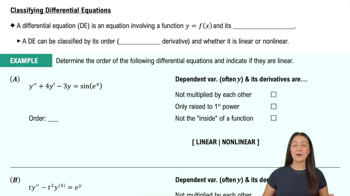
Classifying Differential Equations

Product Rule for Differentiation

The product rule states that the derivative of a product of two functions is the derivative of the first times the second plus the first times the derivative of the second. This rule is essential to rewrite the left side of the equation as a single derivative.
Recommended video:
05:18
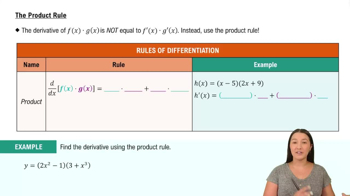
The Product Rule

Integrating Factor Method

This method involves multiplying the entire differential equation by a function (integrating factor) to rewrite the left side as the derivative of a product. It simplifies solving linear first-order equations by enabling direct integration.
Recommended video:
07:33
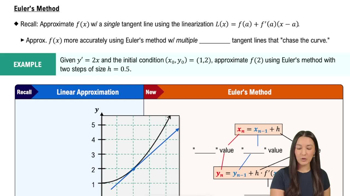
Euler's Method