Ch. 1 - Functions
Briggs - Calculus: Early Transcendentals 3rd Edition
Briggs3rd EditionCalculus: Early TranscendentalsISBN: 9780136847243Not the one you use?Change textbook
Chapter 1, Problem 1.74

Inverse sines and cosines Evaluate or simplify the following expressions without using a calculator.


cos⁻¹ (- 1/2 )

Verified step by step guidance
1
Understand that \( \cos^{-1}(x) \) represents the angle whose cosine is \( x \).
Recall that the range of \( \cos^{-1}(x) \) is \([0, \pi]\).
Identify the angle \( \theta \) in the range \([0, \pi]\) such that \( \cos(\theta) = -\frac{1}{2} \).
Recognize that \( \cos(\pi - \theta) = -\cos(\theta) \), and since \( \cos(\frac{\pi}{3}) = \frac{1}{2} \), then \( \cos(\pi - \frac{\pi}{3}) = -\frac{1}{2} \).
Conclude that \( \theta = \pi - \frac{\pi}{3} \) is the angle in the range \([0, \pi]\) such that \( \cos(\theta) = -\frac{1}{2} \).

Verified video answer for a similar problem:

This video solution was recommended by our tutors as helpful for the problem above.
Video duration:
3m
Was this helpful?

Key Concepts

Here are the essential concepts you must grasp in order to answer the question correctly.

Inverse Trigonometric Functions

Inverse trigonometric functions, such as arcsine and arccosine, are used to find angles when given a ratio of sides in a right triangle. For example, cos⁻¹(x) gives the angle whose cosine is x. These functions are essential for solving problems where the angle is unknown, and they have specific ranges to ensure each output is unique.
Recommended video:
06:35
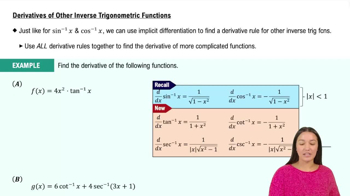
Derivatives of Other Inverse Trigonometric Functions

Range of Inverse Cosine

The range of the inverse cosine function, cos⁻¹(x), is restricted to the interval [0, π]. This means that when evaluating cos⁻¹(-1/2), the resulting angle must fall within this range. Understanding this range is crucial for correctly interpreting the output of the inverse cosine function.
Recommended video:
4:49
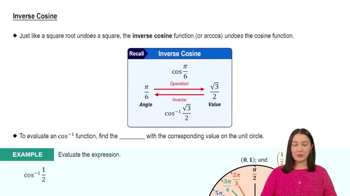
Inverse Cosine

Unit Circle

The unit circle is a fundamental concept in trigonometry that helps visualize the values of trigonometric functions. It is a circle with a radius of one centered at the origin of a coordinate plane. By using the unit circle, one can determine the angles corresponding to specific cosine values, such as -1/2, which corresponds to angles in the second and third quadrants.
Recommended video:
5:10
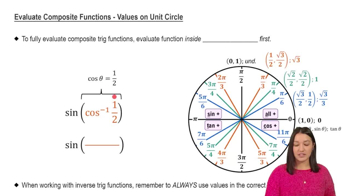
Evaluate Composite Functions - Values on Unit Circle