Ch. 1 - Functions
Briggs - Calculus: Early Transcendentals 3rd Edition
Briggs3rd EditionCalculus: Early TranscendentalsISBN: 9780136847243Not the one you use?Change textbook
Chapter 1, Problem 1.55

Solving equations Solve the following equations.


ln x= -1

Verified step by step guidance
1
Step 1: Understand the equation. The equation given is \( \ln x = -1 \). This means we are looking for a value of \( x \) such that the natural logarithm of \( x \) equals \(-1\).
Step 2: Recall the definition of the natural logarithm. The natural logarithm \( \ln x \) is the power to which \( e \) (Euler's number, approximately 2.718) must be raised to obtain \( x \).
Step 3: Convert the logarithmic equation to an exponential form. The equation \( \ln x = -1 \) can be rewritten as \( x = e^{-1} \).
Step 4: Simplify the expression. The expression \( e^{-1} \) can be simplified to \( \frac{1}{e} \).
Step 5: Conclude the solution. The value of \( x \) that satisfies the equation \( \ln x = -1 \) is \( \frac{1}{e} \).

Verified video answer for a similar problem:

This video solution was recommended by our tutors as helpful for the problem above.
Video duration:
2m
Was this helpful?

Key Concepts

Here are the essential concepts you must grasp in order to answer the question correctly.

Natural Logarithm

The natural logarithm, denoted as ln, is the logarithm to the base e, where e is approximately 2.71828. It is the inverse function of the exponential function, meaning that if y = ln(x), then x = e^y. Understanding the properties of natural logarithms is essential for solving equations involving ln.
Recommended video:
05:18
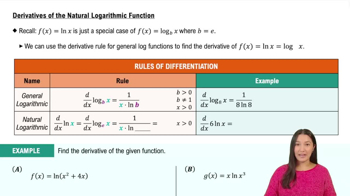
Derivative of the Natural Logarithmic Function

Exponential Function

The exponential function is a mathematical function denoted as e^x, which describes growth or decay processes. It is crucial for solving logarithmic equations, as converting a logarithmic equation to its exponential form allows for easier manipulation. For example, if ln(x) = -1, it can be rewritten as x = e^(-1).
Recommended video:
6:13
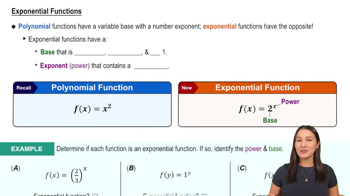
Exponential Functions

Solving Logarithmic Equations

Solving logarithmic equations involves isolating the variable by converting the logarithmic expression into its exponential form. This process often requires understanding the properties of logarithms, such as the product, quotient, and power rules. In the case of ln(x) = -1, applying the exponential function helps find the value of x.
Recommended video:
5:02
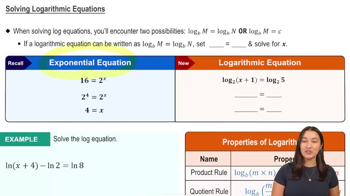
Solving Logarithmic Equations
Related Practice
Textbook Question

Finding all inverses Find all the inverses associated with the following functions, and state their domains.


ƒ(x) = 2 / ( x² + 2)

241
views

Textbook Question

Properties of logarithms Assume logbx = 0.36, logby= 0.56 and logbz = 0.83 . Evaluate the following expressions.


logb x/y

307
views
Textbook Question

More composite functions Let ƒ(x) = | x | , g(x)= x² - 4 , F(x) = √x , G(x) = (1)/(x-2) Determine the following composite functions and give their domains.


G o G

237
views
Textbook Question

State whether the functions represented by graphs A , B , C and in the figure are even, odd, or neither. <IMAGE>

1340
views
Textbook Question

Find the inverse f1(x)f^{-1}\(\left\)(x\(\right\)) of each function (on the given interval, if specified).

f(x)=2x2+1f\(\left\)(x\(\right\))=\(\frac{2}{x^2+1}\), for x0x\(\geq{0}\)

417
views
Textbook Question

The National Weather Service releases approximately 70,00070,000 radiosondes every year to collect data from the atmosphere. Attached to a balloon, a radiosonde rises at about 10001000 ft/min until the balloon bursts in the upper atmosphere. Suppose a radiosonde is released from a point 66 ft above the ground and that 55 seconds later, it is 8383 ft above the ground. Let f(t)f\(\left\)(t\(\right\)) represent the height (in feet) that the radiosonde is above the ground tt seconds after it is released. Evaluate f(5)f(0)50\(\frac{f\left(5\right)-f\left(0\right)}{5-0}\) and interpret the meaning of this quotient.

514
views