
Ch. 11 - Power Series
Briggs - Calculus: Early Transcendentals 3rd Edition
Briggs3rd EditionCalculus: Early TranscendentalsISBN: 9780136847243Not the one you use?Change textbook
Chapter 11, Problem 11.3.67b

Explain why or why not Determine whether the following statements are true and give an explanation or counterexample.
b. The function f(x) = csc x has a Taylor series centered at π/2.

Verified step by step guidance
1
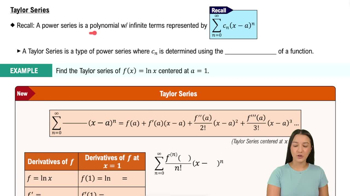
Recall that a Taylor series of a function \(f(x)\) centered at \(a\) is given by the infinite sum \(\sum_{n=0}^{\infty} \frac{f^{(n)}(a)}{n!} (x - a)^n\), where \(f^{(n)}(a)\) denotes the \(n\)-th derivative of \(f\) evaluated at \(x = a\).
To determine if \(f(x) = \csc x\) has a Taylor series centered at \(x = \frac{\pi}{2}\), first check if \(f\) is differentiable at \(x = \frac{\pi}{2}\) and in some open interval around it.
Evaluate \(f\left(\frac{\pi}{2}\right) = \csc\left(\frac{\pi}{2}\right) = 1\), which is finite, so the function is defined at \(x = \frac{\pi}{2}\).
Next, consider the behavior of \(\csc x\) near \(x = \frac{\pi}{2}\). Since \(\sin x\) is nonzero and smooth around \(\frac{\pi}{2}\), \(\csc x = \frac{1}{\sin x}\) is also smooth and infinitely differentiable there.
Therefore, \(f(x) = \csc x\) is infinitely differentiable at \(x = \frac{\pi}{2}\), so it does have a Taylor series centered at \(\frac{\pi}{2}\). The Taylor series converges to \(f(x)\) in some interval around \(\frac{\pi}{2}\) where \(\sin x \neq 0\).

Verified video answer for a similar problem:

This video solution was recommended by our tutors as helpful for the problem above.
Video duration:
1m
Was this helpful?

Key Concepts

Here are the essential concepts you must grasp in order to answer the question correctly.

Taylor Series and Center of Expansion

A Taylor series represents a function as an infinite sum of derivatives at a specific point called the center. The series converges to the function near this point if the function is sufficiently smooth and differentiable there. Understanding the center is crucial to determine if the series exists and converges.
Recommended video:
08:42
Taylor Series

Domain and Differentiability of csc(x)

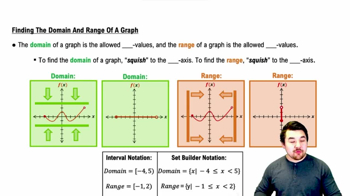
The function csc(x) = 1/sin(x) is undefined where sin(x) = 0, causing vertical asymptotes. For a Taylor series to exist at a point, the function must be defined and infinitely differentiable there. Checking if csc(x) is defined and smooth at π/2 is essential.
Recommended video:
5:10
Finding the Domain and Range of a Graph

Radius of Convergence and Singularities

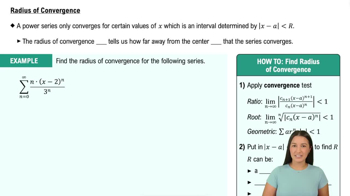
The radius of convergence of a Taylor series is limited by the nearest singularity to the center point. Since csc(x) has singularities where sin(x) = 0, the distance from π/2 to these points affects the convergence. Identifying these singularities helps determine if the Taylor series is valid.
Recommended video:
07:36
Radius of Convergence