Ch. 7 - Logarithmic, Exponential Functions, and Hyperbolic Functions
Briggs - Calculus: Early Transcendentals 3rd Edition
Briggs3rd EditionCalculus: Early TranscendentalsISBN: 9780136847243Not the one you use?Change textbook
Chapter 7, Problem 7.3.57

57–58. Two ways
Evaluate the following integrals two ways.
a. Simplify the integrand first and then integrate.
b. Change variables (let u = ln x), integrate, and then simplify your answer. Verify that both methods give the same answer.
∫ (sinh (ln x)) / x dx

Verified step by step guidance
1
Step 1: Recall the definition of the hyperbolic sine function: \(\sinh(t) = \frac{e^{t} - e^{-t}}{2}\). Use this to rewrite the integrand \(\frac{\sinh(\ln x)}{x}\) in terms of exponentials.
Step 2: Substitute \(t = \ln x\) into the expression for \(\sinh(\ln x)\), so that \(\sinh(\ln x) = \frac{e^{\ln x} - e^{-\ln x}}{2}\). Simplify \(e^{\ln x}\) and \(e^{-\ln x}\) using properties of logarithms and exponentials.
Step 3: After simplification, express the integrand as a function of \(x\) without hyperbolic functions. Then, integrate the resulting expression with respect to \(x\).
Step 4: For the substitution method, let \(u = \ln x\). Then, compute \(du = \frac{1}{x} dx\), which implies \(dx = x du\). Rewrite the integral in terms of \(u\) and \(du\).
Step 5: Substitute into the integral to get \(\int \sinh(u) du\). Integrate \(\sinh(u)\) with respect to \(u\), then substitute back \(u = \ln x\) to express the answer in terms of \(x\). Finally, verify that this result matches the one obtained from the first method.

Verified video answer for a similar problem:

This video solution was recommended by our tutors as helpful for the problem above.
Video duration:
2m
Was this helpful?

Key Concepts

Here are the essential concepts you must grasp in order to answer the question correctly.

Hyperbolic Functions and Their Properties

Hyperbolic functions like sinh(x) are analogs of trigonometric functions but based on exponential functions. Understanding sinh(ln x) involves recognizing that sinh(t) = (e^t - e^{-t})/2, which helps simplify the integrand by expressing it in terms of exponentials.
Recommended video:
06:21
Properties of Functions

Integration by Substitution (Change of Variables)

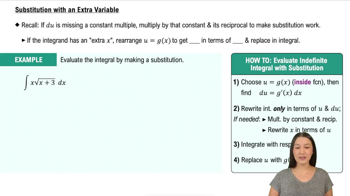
Integration by substitution involves changing the variable of integration to simplify the integral. Setting u = ln x transforms the integral into a function of u, often making it easier to integrate by reducing complexity or revealing standard integral forms.
Recommended video:
04:27
Substitution With an Extra Variable

Simplifying Integrands Before Integration

Simplifying the integrand before integrating can make the integral more straightforward. This may involve algebraic manipulation or rewriting functions in simpler forms, which can reduce the integral to a basic form that is easier to evaluate directly.
Recommended video:
05:22
Completing the Square to Rewrite the Integrand