
Ch. 5 - Integration
Briggs - Calculus: Early Transcendentals 3rd Edition
Briggs3rd EditionCalculus: Early TranscendentalsISBN: 9780136847243Not the one you use?Change textbook
Chapter 5, Problem 5.2.69a

Explain why or why not Determine whether the following statements are true and give an explanation or counterexample.
(a) If ƒ is a constant function on the interval [a,b], then the right and left Riemann sums give the exact value of ∫ₐᵇ ƒ(𝓍) d𝓍, for any positive integer n.

Verified step by step guidance
1
Step 1: Begin by understanding the concept of a constant function. A constant function is one where the value of ƒ(𝓍) remains the same for all 𝓍 in the interval [a, b]. This means ƒ(𝓍) = c, where c is a constant.
Step 2: Recall the definition of the definite integral ∫ₐᵇ ƒ(𝓍) d𝓍. For a constant function, the integral simplifies to c(b - a), where c is the constant value of the function and [a, b] is the interval of integration.
Step 3: Understand the concept of Riemann sums. Both left and right Riemann sums approximate the area under the curve by dividing the interval [a, b] into n subintervals and summing up the areas of rectangles. For a constant function, the height of each rectangle is the same (equal to c), and the width of each subinterval is Δ𝓍 = (b - a)/n.
Step 4: Calculate the left and right Riemann sums for a constant function. Since the height of the rectangles is constant (c), both the left and right Riemann sums will compute the exact area under the curve as c(b - a), regardless of the number of subintervals n.
Step 5: Conclude that the statement is true. For a constant function on [a, b], both the left and right Riemann sums give the exact value of ∫ₐᵇ ƒ(𝓍) d𝓍 for any positive integer n, because the function's value does not vary across the interval, making the approximation exact.

Verified video answer for a similar problem:

This video solution was recommended by our tutors as helpful for the problem above.
Video duration:
4m
Was this helpful?

Key Concepts

Here are the essential concepts you must grasp in order to answer the question correctly.

Riemann Sums

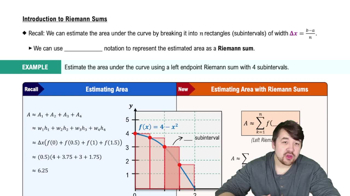
Riemann sums are a method for approximating the integral of a function over an interval by dividing the interval into smaller subintervals. For each subinterval, a sample point is chosen, and the function's value at that point is multiplied by the width of the subinterval. The sum of these products gives an approximation of the area under the curve, which becomes exact as the number of subintervals increases.
Recommended video:
06:11
Introduction to Riemann Sums

Constant Functions

A constant function is a function that always returns the same value regardless of the input. Mathematically, it can be expressed as f(x) = c, where c is a constant. In the context of integration, the area under the curve of a constant function over an interval is simply the product of the constant value and the length of the interval, making it straightforward to calculate using Riemann sums.
Recommended video:
6:13
Exponential Functions

Exact Value of an Integral

The exact value of an integral represents the precise area under the curve of a function over a specified interval. For a constant function, this value can be calculated using the formula ∫ₐᵇ c dx = c(b - a). Riemann sums, when applied to constant functions, yield the exact value because the function's value does not change across the interval, ensuring that both left and right sums converge to the same result.
Recommended video:
06:37
Average Value of a Function
Related Practice
Textbook Question

Bounds on an integral Suppose ƒ is continuous on [a, b] with ƒ''(𝓍) > 0 on the interval. It can be shown that (b―a) ƒ [(a + b) /2] ≤ ∫ₐᵇ ƒ(𝓍) d𝓍 ≤ (b―a) [ (ƒ(a) + ƒ(b)) /2]                                                         


(a) Assuming ƒ is nonnegative on [a, b], draw a figure to illustrate the geometric meaning of these inequalities. Discuss your conclusions. b. 

55
views
Textbook Question

Explain why or why not Determine whether the following statements are true and give an explanation or counterexample. Assume ƒ, ƒ', and ƒ'' are continuous functions for all real numbers.                                                                                                                                                           


(a) ∫ ƒ(𝓍) ƒ'(𝓍) d𝓍 = ½ (ƒ(𝓍))² + C.

44
views
Textbook Question

Matching functions with area functions Match the functions ƒ, whose graphs are given in a― d, with the area functions A (𝓍) = ∫₀ˣ ƒ(t) dt, whose graphs are given in A–D.


49
views
Textbook Question

{Use of Tech} Approximating definite integrals with a calculator Consider the following definite integrals.

(a) Write the left and right Riemann sums in sigma notation for an arbitrary value of n.


∫₀¹ cos ⁻¹ 𝓍 d𝓍

57
views
Textbook Question

Average value with a parameter Consider the function ƒ(𝓍) = a𝓍 (1―𝓍) on the interval [0, 1], where a is a positive real number.

(a) Find the average value of ƒ as a function of a .

84
views
Textbook Question

Area functions for constant functions Consider the following functions ƒ and real numbers a (see figure).

(a) Find and graph the area function A(𝓍) = ∫ₐˣ ƒ(t) dt for ƒ.

ƒ(t) = 5 , a = 0

108
views