
Textbook Question
Euler’s metho d Consider the initial value problem y′(t)=1/2y,y(0)=1.
a. Use Euler’s method with Δt=0.1 to compute approximations to y(0.1) and y(0.2).
52
views

 Verified step by step guidance
 07:39
07:39
 05:03
05:03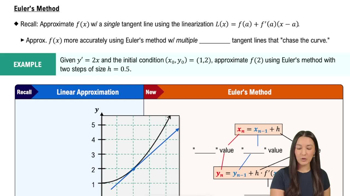 07:33
07:33Euler’s metho d Consider the initial value problem y′(t)=1/2y,y(0)=1.
a. Use Euler’s method with Δt=0.1 to compute approximations to y(0.1) and y(0.2).
Logistic growth in India The population of India was 435 million in 1960 (t=0) and 487 million in 1965 (t=5). The projected population for 2050 is 1.57 billion.
e. Discuss some possible shortcomings of this model. Why might the carrying capacity be either greater than or less than the value predicted by the model?
Direction fields Consider the direction field for the equation y′=y(2−y) shown in the figure and initial conditions of the form y(0)=A.
d. For what values of A are the corresponding solutions decreasing, for t≥0
A predator-prey model Consider the predator-prey model
x′(t) = −4x + 2xy, y′(t) = 5y − xy
c. Find the equilibrium points for the system.
Direction fields The direction field for the equation y′(t)=t−y, for |t|≤4 and |y|≤4, is shown in the figure.
b. Use the direction field to sketch the solution curve that passes through the point (0,−1/2).
7–16. Verifying general solutions Verify that the given function is a solution of the differential equation that follows it. Assume C, C1, C2 and C3 are arbitrary constants.
u(t) = C₁t⁵ + C₂t⁻⁴ - t³; t²u''(t) - 20u(t) = 14t³