Ch. 2 - Limits
Briggs - Calculus: Early Transcendentals 3rd Edition
Briggs3rd EditionCalculus: Early TranscendentalsISBN: 9780136847243Not the one you use?Change textbook
Chapter 2, Problem 83a

a. Use the Intermediate Value Theorem to show that the equation has a solution in the given interval.


x=cos x; (0,π/2)

Verified step by step guidance
1
Identify the function for which we need to apply the Intermediate Value Theorem. Define the function as f(x) = x - cos(x).
Evaluate the function at the endpoints of the interval. Calculate f(0) and f(π/2).
Calculate f(0): Substitute x = 0 into the function, f(0) = 0 - cos(0). Since cos(0) = 1, f(0) = 0 - 1 = -1.
Calculate f(π/2): Substitute x = π/2 into the function, f(π/2) = π/2 - cos(π/2). Since cos(π/2) = 0, f(π/2) = π/2 - 0 = π/2.
Apply the Intermediate Value Theorem: Since f(0) = -1 and f(π/2) = π/2, and because -1 < 0 < π/2, there exists a c in the interval (0, π/2) such that f(c) = 0. Therefore, the equation x = cos(x) has a solution in the interval (0, π/2).

Verified video answer for a similar problem:

This video solution was recommended by our tutors as helpful for the problem above.
Video duration:
9m
Was this helpful?

Key Concepts

Here are the essential concepts you must grasp in order to answer the question correctly.

Intermediate Value Theorem

The Intermediate Value Theorem states that if a function is continuous on a closed interval [a, b], and takes on different values at the endpoints, then it must take on every value between those endpoints at least once. This theorem is crucial for proving the existence of solutions to equations within a specified interval.
Recommended video:
06:11
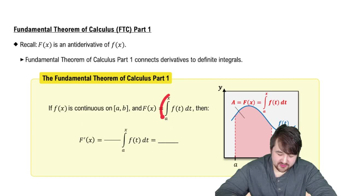
Fundamental Theorem of Calculus Part 1

Continuity of Functions

A function is continuous if there are no breaks, jumps, or holes in its graph. For the Intermediate Value Theorem to apply, the function in question must be continuous over the interval. In this case, both x and cos x are continuous functions, which is essential for applying the theorem.
Recommended video:
05:34
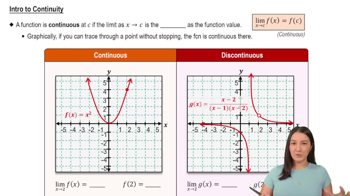
Intro to Continuity

Fixed Point Theorem

The Fixed Point Theorem relates to finding points where a function intersects the line y = x. In the context of the equation x = cos x, we can reformulate it to f(x) = x - cos x. Finding a solution involves showing that f(x) changes sign over the interval, indicating a fixed point exists where the function equals zero.
Recommended video:
05:22
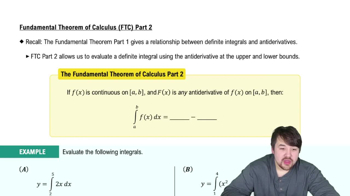
Fundamental Theorem of Calculus Part 2