


Ch. 3 - Derivatives
Hass - Thomas' Calculus 15th Edition
Hass15th EditionThomas' CalculusISBN: 9780137616077Not the one you use?Change textbook
Chapter 3, Problem 3.65

In Exercises 65 and 66, find the derivative using the definition.


ƒ(t) = 1 .
2t + 1

Verified step by step guidance
1
Start by recalling the definition of the derivative. The derivative of a function ƒ(t) at a point t is given by the limit: lim(h→0) [(ƒ(t + h) - ƒ(t)) / h].
Substitute the given function ƒ(t) = 1/(2t + 1) into the definition. You need to find ƒ(t + h) first, which is 1/(2(t + h) + 1).
Calculate the difference ƒ(t + h) - ƒ(t). This will be: [1/(2(t + h) + 1)] - [1/(2t + 1)].
Simplify the expression for ƒ(t + h) - ƒ(t) by finding a common denominator, which is (2(t + h) + 1)(2t + 1).
Substitute the simplified expression into the derivative definition and evaluate the limit as h approaches 0: lim(h→0) {[(2t + 1) - (2(t + h) + 1)] / [h(2(t + h) + 1)(2t + 1)]}.

Verified video answer for a similar problem:

This video solution was recommended by our tutors as helpful for the problem above.
Video duration:
4m
Was this helpful?

Key Concepts

Here are the essential concepts you must grasp in order to answer the question correctly.

Derivative Definition

The derivative of a function at a point is defined as the limit of the average rate of change of the function as the interval approaches zero. Mathematically, it is expressed as f'(a) = lim (h -> 0) [f(a + h) - f(a)] / h. This definition is fundamental for understanding how functions change and is the basis for calculating derivatives.
Recommended video:
05:43
Definition of the Definite Integral

Limit

A limit is a fundamental concept in calculus that describes the behavior of a function as it approaches a particular point. It is essential for defining derivatives, as the derivative itself is a limit. Understanding limits helps in analyzing the continuity and behavior of functions near specific values.
Recommended video:
05:50
One-Sided Limits

Function Composition

Function composition involves combining two functions where the output of one function becomes the input of another. In the context of finding derivatives, it is important to understand how to manipulate functions, especially when applying the definition of the derivative to more complex expressions. This concept is crucial for simplifying the calculations involved in differentiation.
Recommended video:
3:48
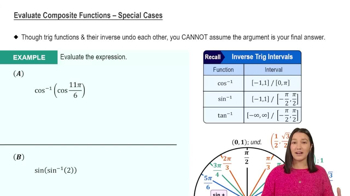
Evaluate Composite Functions - Special Cases