
Ch. 8 - Integration Techniques
Briggs - Calculus: Early Transcendentals 3rd Edition
Briggs3rd EditionCalculus: Early TranscendentalsISBN: 9780136847243Not the one you use?Change textbook
Chapter 8, Problem 8.5.82

76–83. Preliminary steps The following integrals require a preliminary step such as a change of variables before using the method of partial fractions. Evaluate these integrals.
82. ∫ [dx / (x√(1 + 2x))]

Verified step by step guidance
1
Identify the integral to solve: \(\int \frac{dx}{x \sqrt{1 + 2x}}\).
Recognize that the expression under the square root, \$1 + 2x\(, suggests a substitution to simplify the radical. Let \(t = \sqrt{1 + 2x}\), so that \)t^2 = 1 + 2x$.
Differentiate both sides of \(t^2 = 1 + 2x\) with respect to \(x\) to find \(dx\) in terms of \(dt\): \(2t \frac{dt}{dx} = 2\), which implies \(\frac{dt}{dx} = \frac{1}{t}\), so \(dx = t \, dt\).
Express \(x\) in terms of \(t\) from \(t^2 = 1 + 2x\): \(x = \frac{t^2 - 1}{2}\). Substitute \(x\) and \(dx\) back into the integral to rewrite it entirely in terms of \(t\).
Simplify the integral after substitution and then proceed to use partial fractions or other integration techniques as appropriate to evaluate the integral.

Verified video answer for a similar problem:

This video solution was recommended by our tutors as helpful for the problem above.
Video duration:
9m
Was this helpful?

Key Concepts

Here are the essential concepts you must grasp in order to answer the question correctly.

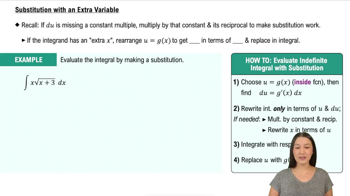
Substitution Method (Change of Variables)

This technique involves replacing a complicated expression with a simpler variable to make integration easier. For example, setting u = 1 + 2x transforms the integral into a function of u, simplifying the square root and rational expressions. It is often the first step before applying other integration methods.
Recommended video:
04:27
Substitution With an Extra Variable

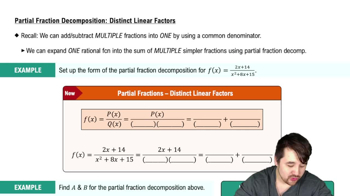
Partial Fraction Decomposition

Partial fractions break down a complex rational function into simpler fractions that are easier to integrate. After substitution, the integrand often becomes a rational function suitable for this method, allowing the integral to be expressed as a sum of simpler terms.
Recommended video:
10:07
Partial Fraction Decomposition: Distinct Linear Factors

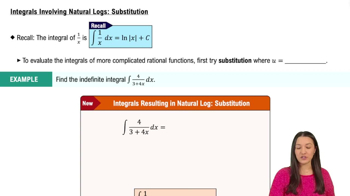
Integration of Rational Functions Involving Roots

Integrals containing roots like √(1 + 2x) often require manipulation to rewrite the integrand in a rational form. Understanding how to handle expressions with roots and convert them into integrable forms is essential, often combining substitution and partial fractions.
Recommended video:
07:01
Integrals Involving Natural Logs: Substitution
Related Practice
Textbook Question

7–40. Table look-up integrals Use a table of integrals to evaluate the following indefinite integrals. Some of the integrals require preliminary work, such as completing the square or changing variables, before they can be found in a table.

31. ∫ √(x² - 8x) dx, x > 8

65
views
Textbook Question

63. (Use of Tech) Normal distribution of heights

The heights of U.S. men are normally distributed with a mean of 69 in and a standard deviation of 3 in. This means that the fraction of men with a height between a and b (with a < b) inches is given by the integral

(1/(3√(2π))) ∫ₐᵇ e^(-((x-69)/3)²/2) dx.

What percentage of American men are between 66 and 72 inches tall? Use the method of your choice, and experiment with the number of subintervals until you obtain successive approximations that differ by less than 10⁻³.

74
views
Textbook Question

9–61. Trigonometric integrals Evaluate the following integrals.

16. ∫ sin²θ cos⁵θ dθ

132
views
Textbook Question

29-34. {Use of Tech} Comparing the Midpoint and Trapezoid Rules

Apply the Midpoint and Trapezoid Rules to the following integrals. Make a table similar to Table 8.5 showing the approximations and errors for n = 4, 8, 16, and 32. The exact values of the integrals are given for computing the error.

33. ∫(0 to π) sin x cos(3x) dx = 0

70
views
Textbook Question

7–84. Evaluate the following integrals.

33. ∫ [eˣ / (a² + e²ˣ)] dx, where a ≠ 0

61
views
Textbook Question

7–64. Integration review Evaluate the following integrals.

12. ∫ from -5 to 0 of dx / √(4 - x)

48
views