Suppose f(x)→100 and g(x)→0, with g(x)<0 as x→2. Determine lim x→2 f(x) / g(x).
Ch. 2 - Limits
Briggs3rd EditionCalculus: Early TranscendentalsISBN: 9780136847243Not the one you use?Change textbook
Chapter 2, Problem 2.4.56
Find polynomials p and q such that f=p/q is undefined at 1 and 2, but f has a vertical asymptote only at 2. Sketch a graph of your function.
Verified step by step guidance1
Step 1: Understand the problem requirements. We need to find polynomials p(x) and q(x) such that the rational function f(x) = \(\frac{p(x)}{q(x)}\) is undefined at x = 1 and x = 2, but has a vertical asymptote only at x = 2.
Step 2: Recall that a rational function is undefined where its denominator is zero. To make f(x) undefined at x = 1 and x = 2, q(x) should have factors (x - 1) and (x - 2).
Step 3: To ensure a vertical asymptote at x = 2, the factor (x - 2) should not be canceled out by the numerator p(x). Therefore, p(x) should not have the factor (x - 2).
Step 4: To make f(x) defined at x = 1, the factor (x - 1) in q(x) should be canceled by a similar factor in p(x). Thus, p(x) should have the factor (x - 1).
Step 5: Construct the polynomials. Let p(x) = (x - 1) and q(x) = (x - 1)(x - 2). This ensures f(x) = \(\frac{(x - 1)}{(x - 1)(x - 2)}\) is undefined at x = 1 and 2, but has a vertical asymptote only at x = 2.

Verified video answer for a similar problem:
This video solution was recommended by our tutors as helpful for the problem above.
Video duration:
5mKey Concepts
Here are the essential concepts you must grasp in order to answer the question correctly.
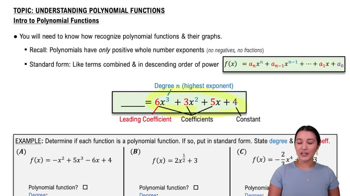
Polynomials
Polynomials are mathematical expressions consisting of variables raised to non-negative integer powers and coefficients. They can be represented in the form p(x) = a_n*x^n + a_(n-1)*x^(n-1) + ... + a_1*x + a_0, where a_n are constants and n is a non-negative integer. Understanding polynomials is crucial for constructing rational functions, as they form the numerator and denominator in the expression f = p/q.
Recommended video:
Introduction to Polynomial Functions
Vertical Asymptotes
Vertical asymptotes occur in rational functions when the denominator approaches zero while the numerator remains non-zero, leading to the function tending towards infinity. For the function f = p/q to have a vertical asymptote at x = 2, the polynomial q must have a factor (x - 2) that causes q(2) = 0, while p(2) must not equal zero. This concept is essential for determining the behavior of the function near specific points.
Recommended video:
Guided course
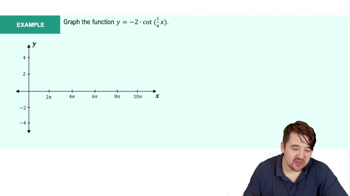
Introduction to Cotangent Graph Example 1
Undefined Points
A function is undefined at points where its denominator equals zero, as division by zero is not permissible. In the context of the given question, the function f = p/q must be undefined at x = 1 and x = 2, meaning that q must have factors (x - 1) and (x - 2). However, to ensure a vertical asymptote only at x = 2, the factor (x - 1) must be canceled out in the numerator p, which influences the overall behavior of the function.
Recommended video:
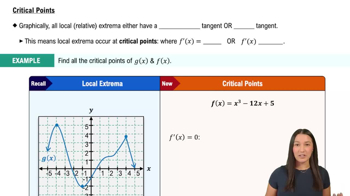
Critical Points
Related Practice
Textbook Question
408
views
Textbook Question
Determine the following limits.
lim x→∞ sin x / e^x
470
views
Textbook Question
If a function f represents a system that varies in time, the existence of lim means that the system reaches a steady state (or equilibrium). For the following systems, determine whether a steady state exists and give the steady-state value.
The population of a colony of squirrels is given by .
366
views
Textbook Question
Determine the following limits.
354
views
Textbook Question
Determine the interval(s) on which the following functions are continuous.
p(x)=3x^2−6x+7 / x^2+x+1
286
views
Textbook Question
Determine the interval(s) on which the following functions are continuous. At which finite endpoints of the intervals of continuity is f continuous from the left or continuous from the right?
f(x)=(2x−3)^2/3
252
views